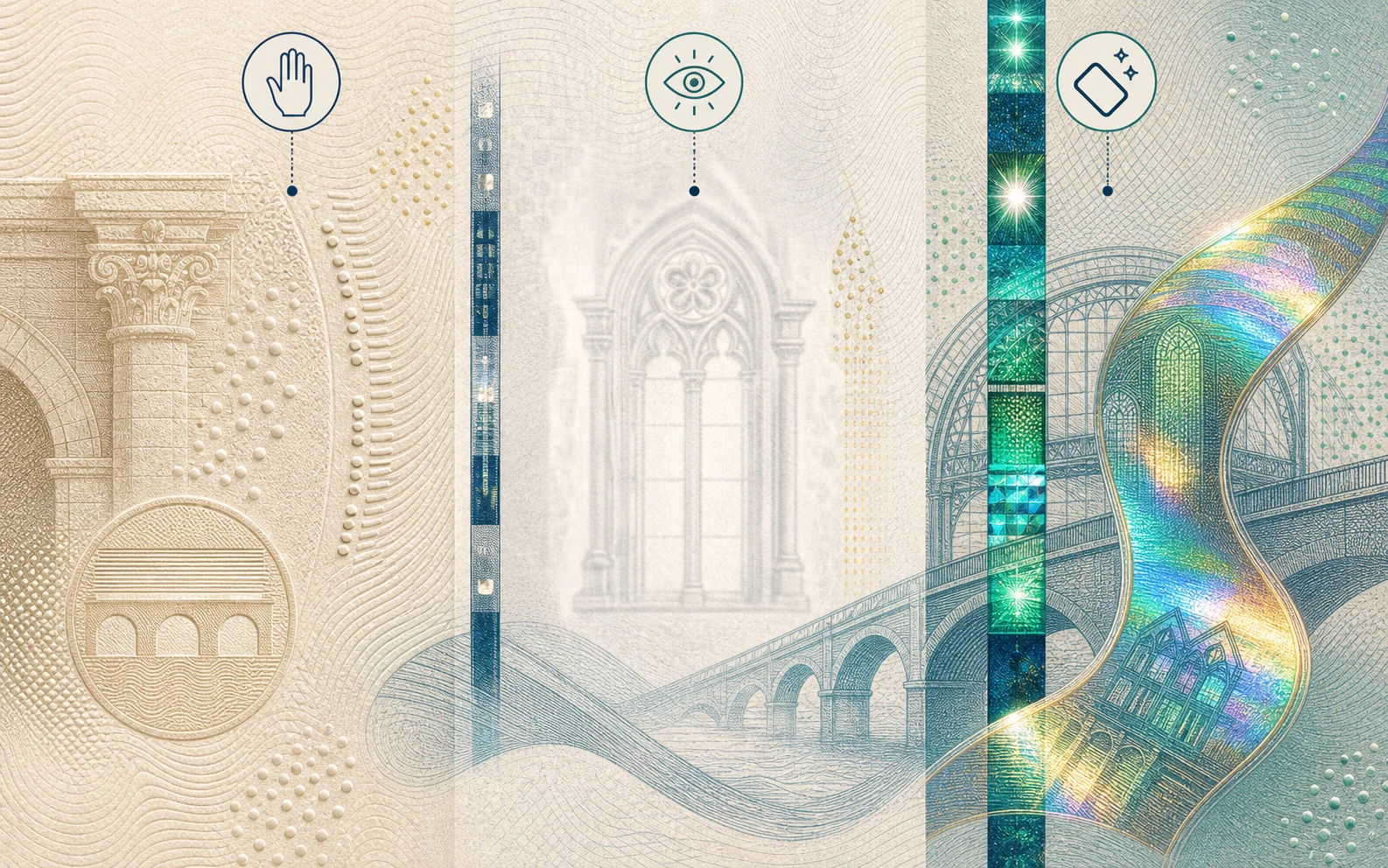
Euro banknotes are designed so that many of their main security features can be checked without special equipment. The European Central Bank presents the basic method in three actions: feel, look and tilt.
That simplicity is important. A banknote may be handled by a shopkeeper, a traveller, a collector, a bank employee or a person receiving change at a cafe. The first check should not require a microscope. It should begin with the senses: the touch of the paper, the image visible against the light and the features that change when the note is moved.
The method in one minute
The most useful habit is not to rely on a single sign. A genuine euro banknote combines paper, printing, watermark, thread, hologram and colour-changing effects. A suspicious note should therefore be checked through more than one feature, preferably against a note that is already known to be genuine.
| Method | What to check | Purpose |
|---|---|---|
| Feel | Paper, firmness and raised print. | The banknote should not feel like ordinary paper, and parts of the print should be tactile. |
| Look | Watermark, security thread and, on some Europa notes, the portrait window. | Features embedded in the note become visible when it is held against the light. |
| Tilt | Hologram, emerald number and other colour-changing elements. | Optical features should change with the viewing angle rather than remain flat and static. |
This is a practical screening method, not a professional authentication certificate. It is meant to help ordinary users recognise obvious warning signs and understand the security logic behind the notes.
Feel: paper and raised print
Euro banknotes are printed on cotton paper. In normal use, this gives them a firm and slightly crisp feel, different from common writing or photocopy paper. A note that feels limp, waxy, unusually smooth or obviously paper-like deserves more attention.
The second tactile clue is raised print. Some parts of the design are printed in relief, so they can be felt by passing a fingertip lightly over the surface. On the Europa series, the short raised lines near the left and right edges are especially important because they help visually impaired users recognise the notes by touch.
On a heavily worn genuine note, tactile features may be less sharp than on a fresh one. That is why touch should be the beginning of the check, not the end of it.
Look: watermark, thread and window
The next step is to hold the banknote against the light. On both the first series and the Europa series, this reveals security elements that are part of the note rather than simply printed on the surface.
The watermark appears in the lighter area of the note. In the first series it shows the architectural motif and the value. In the Europa series it includes Europa’s portrait, the value and the main image. The transition should look soft and integrated, not like a hard printed patch.
The security thread is another key feature. When viewed against the light, it appears as a dark vertical line. Depending on the series and denomination, the thread also contains small lettering or value signs.
Some Europa series banknotes add a portrait window. On the 20, 50, 100 and 200 euro notes, the window in the hologram area becomes transparent when held against the light and shows a portrait of Europa on both sides.
Tilt: hologram and colour shift
The tilt check is the most visual part of the method. When the note is moved, the hologram and colour-changing features should react to the angle of light.
On the first series, the hologram appears either as a stripe on the lower denominations or as a patch on the higher denominations. The 5, 10 and 20 euro notes also have a glossy stripe on the back, while the 50, 100, 200 and 500 euro notes have a colour-changing number.
On the Europa series, the emerald number is one of the easiest features to notice. When the note is tilted, the number shows a light effect that moves and shifts colour from emerald green to a deeper blue. The portrait hologram also reveals Europa’s portrait, the value and the main architectural image.
The 100 and 200 euro notes in the Europa series include an additional satellite hologram. When tilted, small euro symbols move around the number. This is a useful example of how the later notes refined the same basic rule: security features should behave dynamically under light.

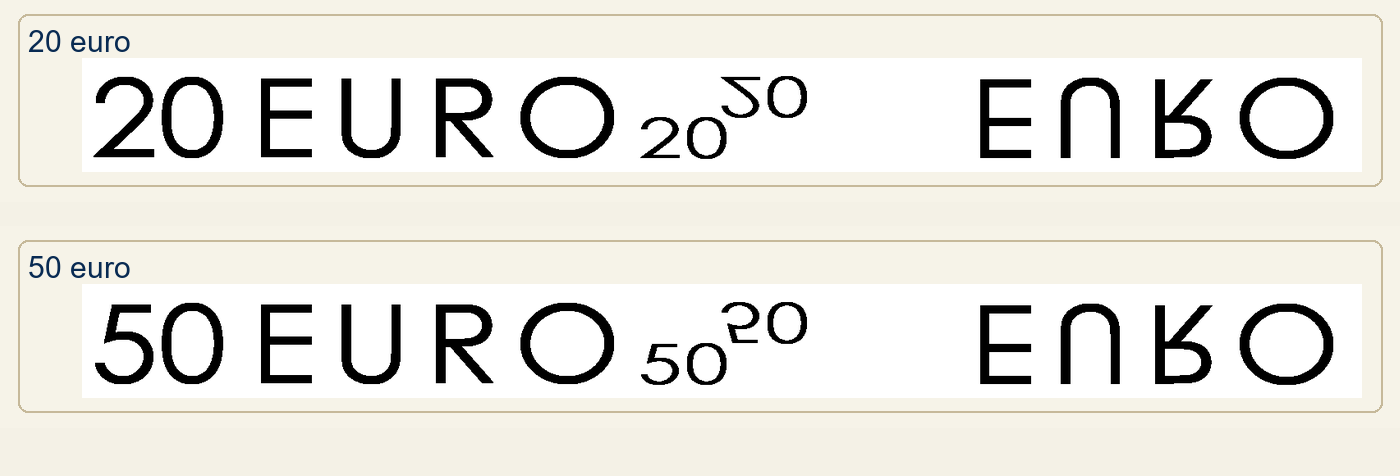
Europa-series 20 euro: the silvery stripe on the right carries the portrait window and the portrait hologram, while the lower-left number shows the emerald-to-blue colour shift on tilt.
First series and Europa series
The first euro banknotes and the Europa series share the same broad visual language, but their security features are not identical. This is why a reader should first identify the series before comparing individual details.
The first series relies on the original combination of cotton paper, raised print, watermark, security thread, hologram and denomination-specific effects such as the glossy stripe or colour-changing number.
The Europa series keeps the familiar architectural identity but adds the portrait of Europa to important security features. It also uses the emerald number, updated holographic elements and, on the larger Europa denominations, the portrait window.
This is why a quick general check and the denomination-by-denomination security features are worth keeping apart: the feel, look and tilt method is useful to everyone, while the detailed features of each series reward a closer look.
If a note seems suspicious
If a banknote looks wrong after the feel, look and tilt checks, it should not be accepted or passed on. The ECB’s anti-counterfeiting guidance is clear that a suspected counterfeit should be taken seriously and reported through the appropriate channels, such as a bank, the police or the relevant national authority.
For normal users, the safest approach is simple: do not argue from one detail alone, do not return a suspicious note to circulation, and do not put yourself at risk. If possible, compare it with a genuine note of the same denomination and series, then ask a bank or competent authority to check it.
A check the public can perform alone
The point of the feel-look-tilt method is that it does not require special equipment. It also does not require memory of every detail at once. Three movements — paper between fingers, note against the light, note tilted in the hand — are enough to reach a first useful judgment.
What the method cannot give is a final verdict. A suspicious banknote should still go to a bank or competent authority for assessment, and a high-value or damaged note still needs careful handling. The series-specific features are explained in more depth in the articles on first-series security features and Europa-series security features.