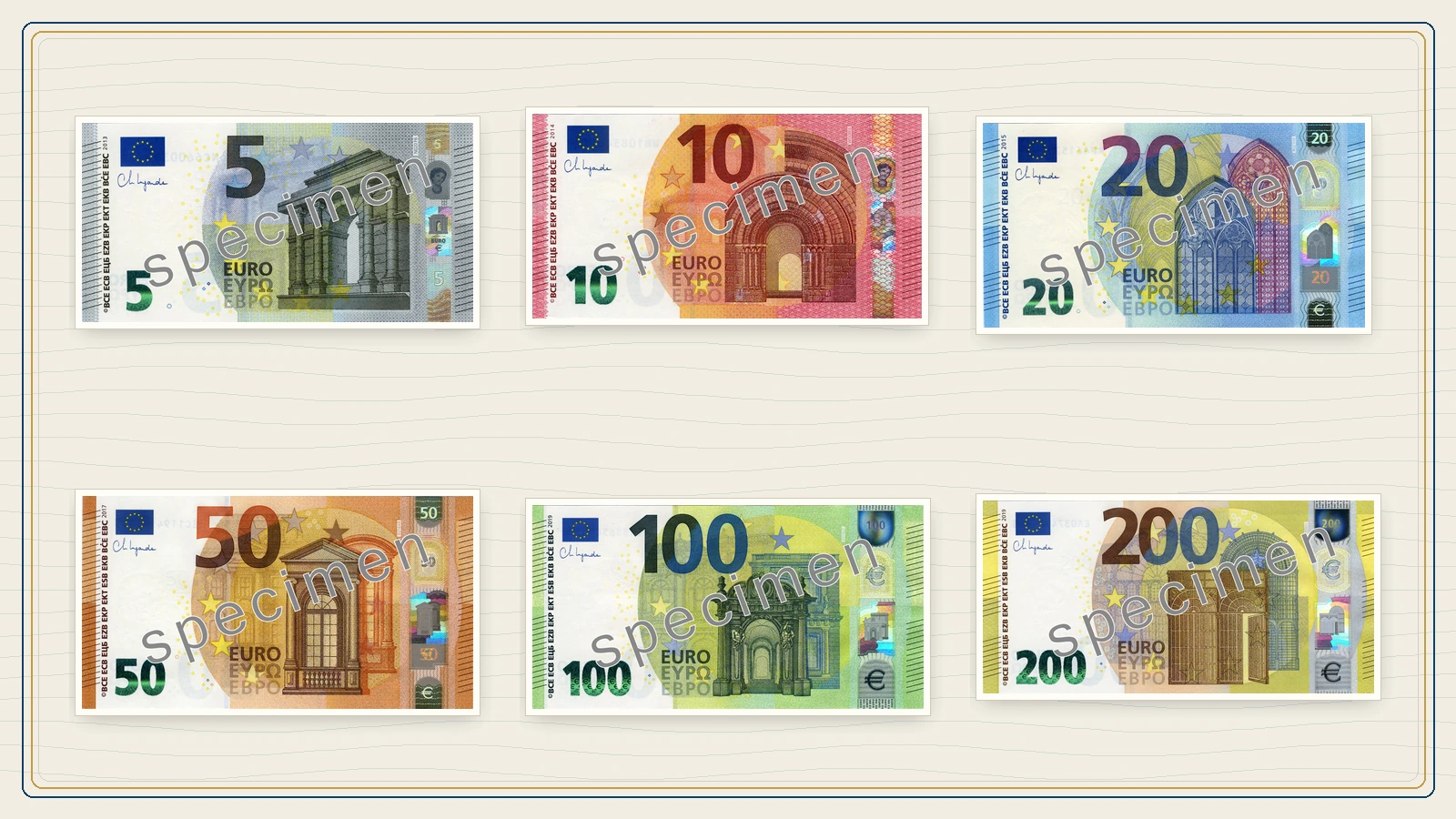
The Europa series is the second generation of euro banknotes. Unlike the first series, which entered circulation as a complete set in 2002, the Europa series was introduced gradually: first the 5 euro note in 2013, then the 10, 20 and 50 euro notes, and finally the 100 and 200 euro notes on 28 May 2019.
It is called the Europa series because two of its security features contain a portrait of Europa, a figure from Greek mythology. The choice is practical as well as symbolic: the portrait gives the banknotes a recognisable human element and makes several security checks easier to explain.
The need for a second series
Banknotes are handled constantly, checked by machines and people, and targeted by counterfeiters. For that reason, central banks update them over time. The ECB describes the Europa series as more secure against counterfeiting and more durable than the first series, meaning the notes need to be replaced less often.
This is the quiet logic behind the redesign. The Europa series does not abandon the identity of the euro. It strengthens it. The same broad visual language remains: gateways and windows on the front, bridges on the back, architectural styles from different periods of European history and no real monuments.
A refreshed design, not a new theme
The Europa series keeps the “Ages and styles” theme introduced with the first euro banknotes. The difference is in the treatment. The predominant colour of each denomination is unchanged from 2002, but its intensity is stronger and gives the notes greater three-dimensionality; the notes also accommodate new security features.
Robert Kalina’s original design was revised by the German designer Reinhold Gerstetter, who had already created the last series of German mark banknotes and some notes for the Banco de España. Gerstetter made many elements more rounded, to convey greater three-dimensionality, and integrated the new security systems, respecting an already familiar currency while making the new notes easy to distinguish from the first series.

Europa-series 50 euro, the most produced denomination of the current series, here with Christine Lagarde’s signature.
The six denominations
The Europa series consists of six denominations: 5, 10, 20, 50, 100 and 200 euro. The 500 euro banknote was not included in this second series.
| Denomination | First circulated | Dominant colour | Europa-series size |
|---|---|---|---|
 5 euro 5 euro | 2 May 2013 | Grey | 120 x 62 mm |
 10 euro 10 euro | 23 September 2014 | Red | 127 x 67 mm |
 20 euro 20 euro | 25 November 2015 | Blue | 133 x 72 mm |
| 50 euro | 4 April 2017 | Orange | 140 x 77 mm |
 100 euro 100 euro | 28 May 2019 | Green | 147 x 77 mm |
 200 euro 200 euro | 28 May 2019 | Yellow-brown | 153 x 77 mm |
The widths match the corresponding first-series denominations. The most visible dimensional change is in the 100 and 200 euro notes, whose height was reduced from 82 mm to 77 mm. This makes the two higher denominations the same height as the 50 euro note.
Europa’s portrait
The portrait of Europa appears in security features rather than as a conventional banknote portrait. The ECB explains that the image was taken from a vase in the Louvre in Paris. It appears in the watermark and in the hologram, helping users recognise the series through the simple “feel, look and tilt” method.
This is a significant shift from the first series. The original euro banknotes avoided portraits altogether. The Europa series introduces a human face, but does so through security design rather than national commemoration.

Europa’s portrait in the hologram of the 10 euro banknote.
Language and map changes
The Europa series also reflects changes in the European Union after the first euro banknotes were designed. The name of the currency appears not only in Latin and Greek alphabets, as on the first series, but also in Cyrillic as ЕВРО, following Bulgaria’s accession to the EU.
The initials of the European Central Bank also appear in more linguistic variants than on the first series: from the five on the first series (BCE, ECB, EZB, EKT, EKP) to the nine on the Europa series (BCE, ECB, ЕЦБ, EZB, EKP, EKT, EKB, BĊE and EBC), reflecting the EU enlargements after 2002. Next to the acronym, the copyright symbol ”©” remains on the left and the year of first issue on the right; the year, however, varies with the denomination, following the rollout schedule: 2013 (5 euro), 2014 (10 euro), 2015 (20 euro), 2017 (50 euro) and 2019 (100 and 200 euro).
On the back, the map of Europe was revised. On the first series it sat on the centre-right; on the Europa series it moved to the bottom-left and “widened” to include Malta and Cyprus, two of the countries that joined the European Union after 2002 and were absent from the first series map.
The missing Europa-series 500
The Europa series has no 500 euro denomination. In May 2016 the ECB announced that it would permanently stop producing and issuing the 500 euro banknote and exclude it from the Europa series.
That does not mean the first-series 500 euro note became worthless. The ECB states that it remains legal tender, will always retain its value and can be exchanged at any national central bank in the euro area.
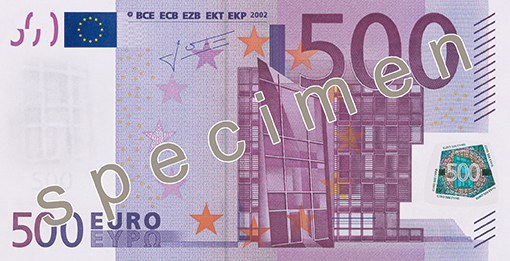
The 500 euro belongs to the first series and was not carried into the Europa series; notes already issued remain valid.
This makes the 500 euro note an important boundary between the first and second series. It belongs to the original architecture of the euro, but not to the current production set.
The current face of euro cash
For a casual user, the Europa series is simply the current euro banknote set. For collectors, it is a richer transition point: new security features, updated signatures, revised printing codes, a different serial-number structure and the absence of the 500 euro denomination.
Seen this way, the Europa series is not just a second edition. It is the point where a familiar currency was made more durable, more secure and easier to verify, while still looking recognisably like the euro people first met in 2002.

