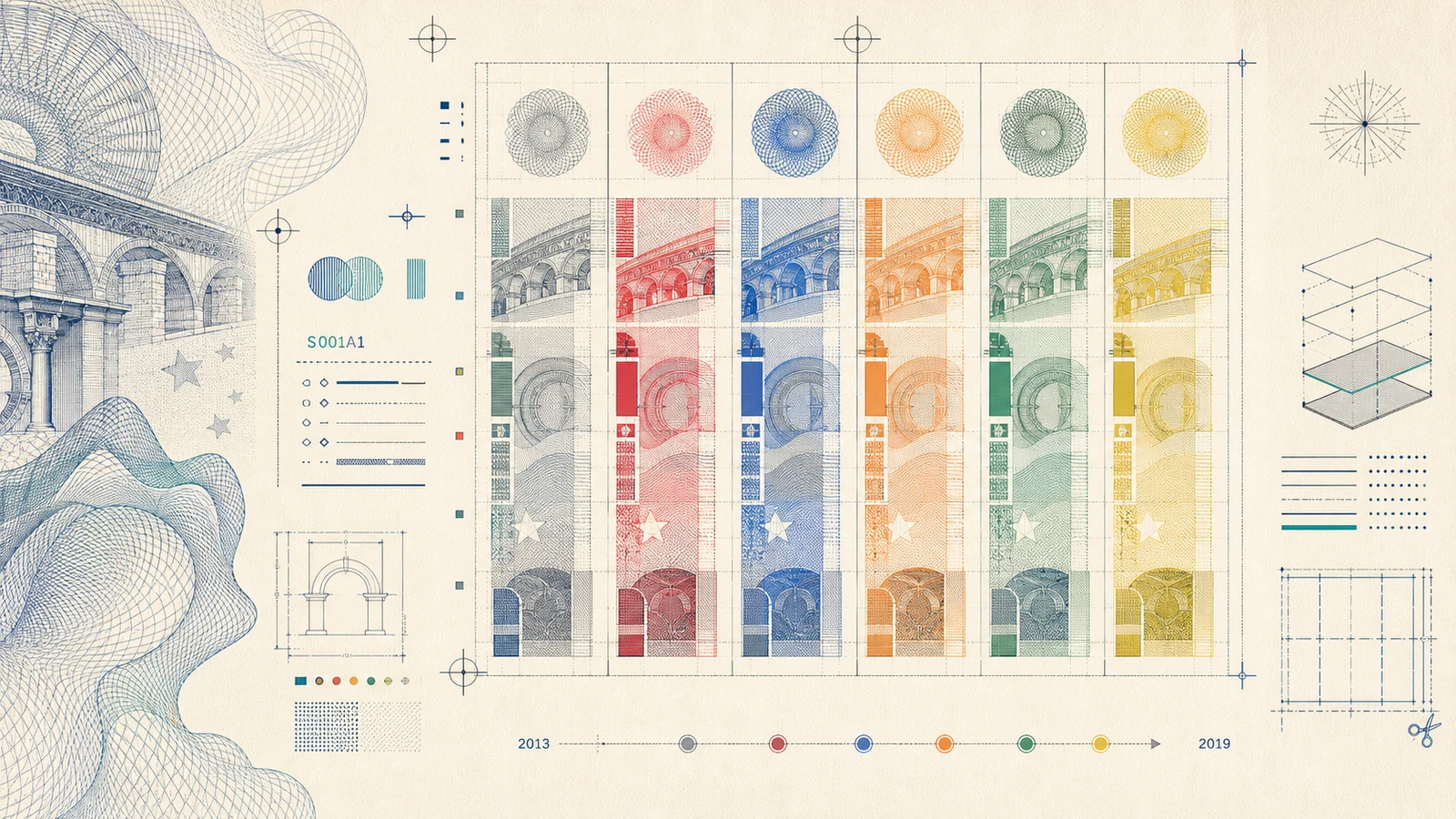
The Europa series arrived one denomination at a time — the 5 euro in 2013, then the 10, 20 and 50, and finally the 100 and 200 together on 28 May 2019, with no 500. That staggered rollout left the six denominations with very different production records, across 804 documented runs.
Choose a denomination
 5 euro100 runs · issued 2013
 10 euro126 runs · issued 2014
 20 euro192 runs · issued 2015
 50 euro298 runs · issued 2017
 100 euro61 runs · issued 2019
 200 euro27 runs · issued 2019
One letter per printing works
The Europa series rebuilt the letter system the first series used. Instead of one alphabet for national associations and a second for printing works, each works now has a single letter that opens both the serial number and the production code. For the Banca d’Italia works that letter is S, so a code that read J001A1 on the first series reads S001A1 here.
The consequence for the tables is that country and printer no longer diverge as sharply as they do on the older notes, and that a code from one series cannot be read with the rules of the other. The printer-code guide lists every assigned letter in both schemes.
The fields kept in each row are the same as for the first series: country and code, signatory, printer letter and works, plate run, sheet format and numbering, rarity grade and reference price. Source rows, source URLs and the proprietary mnemonic code were removed before the extract was prepared, and incomplete records were excluded. Unlike the first series, the Europa extract records no separate printing year, so the signature is the main chronological marker: Draghi from 2013, Lagarde from November 2019.
How rarity and quotation are worked out
The rarity grade uses the Cartamoneta catalogue scale — C3, C2, C, NC, then R through R5 — and is calculated from how far a documented run sits above the ordinary level for its own denomination. That relative approach matters even more here than in the first series, because Europa notes are young: an ordinary 200 euro is catalogued barely above its face value, while an ordinary 5 euro already carries a visible premium.
Runs the catalogue declines to price keep the catalogue’s own rarity code instead. Those appear in italics with no quotation, because a figure would imply a market that does not exist for a run known from a few examples.
Every quotation shown is for one condition only: gem uncirculated, GEM-UNC, the top of the grading scale. It is the Cartamoneta.com reference — the catalogue figure with the mark-up published for that denomination, rounded up to the next step. Above a threshold set per denomination (€500 on the 5 euro, €1,000 on the 20, €1,500 on the 50, €1,750 on the 100) the mark-up gives way to a 10% reduction; the 200 euro is never reduced. A circulated banknote is worth less. The figure is indicative, not an offer and not a valuation of a particular banknote.
Reading a young catalogue
The Europa record is still being written. The 100 and the 200 euro have been in circulation only since 2019, so their tables are short and their prices cluster; the 50 euro, in circulation since 2017 and the commonest note in the euro area, already fills three hundred rows.
Short tables invite over-interpretation. A denomination with few documented runs is not automatically scarce, and a run recorded once can still cover millions of banknotes. For the physical checks, read the Europa-series security features and how to decode euro serial numbers alongside the denomination page.
