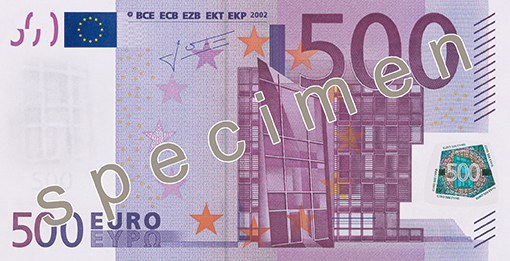
Everything recorded about the first-series 500 euro banknote: 31 documented runs, each with its printing works, signature, plate, sheet position, rarity grade and GEM-UNC quotation. Search or filter the table, then read the notes below it.
31 of 31 rows shown
Scroll sideways to see every column.
No record matches this search.
Rarity on the Cartamoneta catalogue scale: C3 extremely common, C2 very common, C common, NC not common, then R to R5. Italic grades come from the catalogue itself and mark the runs it does not price. Quotations are for gem uncirculated banknotes (GEM-UNC).
How to read the table
It holds the 31 records the cleaned extract keeps for this denomination. Twenty rows load at a time; the search box and the filters always run over the whole list, so a match is found first and the rows around it are loaded afterwards.
Rarity uses the scale printed in the Cartamoneta catalogue, from C3 (extremely common) up to R5 (of the highest rarity). It is derived from how far a run sits above the ordinary level for this denomination, because the ratio between face value and catalogue reference is not comparable across denominations. Where the catalogue supplies its own grade instead of a price, that grade is shown in italics and no quotation appears.
Every quotation is for a gem uncirculated banknote — GEM-UNC, the top of the grading scale — and for no other condition. It is the Cartamoneta.com reference: the catalogue figure with the published mark-up for this denomination, rounded up to the next step. From a threshold upwards — €500 on the 5 euro, €750 on the 10, €1,000 on the 20, €1,500 on the 50, €1,750 on the 100 — the mark-up gives way to a 10% reduction, because high-value examples are placed by negotiation rather than at a premium; the 200 and 500 euro are never reduced. A circulated example is worth less, often much less. The figure is an indicative reference and not an offer, an appraisal or a statement about the condition of any particular banknote.
The purple 500 is the only denomination the euro has stopped issuing, and the only one with no Europa-series successor. Production ended in 2019; the notes remain legal tender and can still be exchanged at national central banks without a time limit.
Five printing works, and then none
Only five works appear in the extract for this denomination, with printing years from 2001 to 2014. The ECB announced the end of production in May 2016 and the last national central banks stopped issuing in April 2019, which closes the table permanently: no new first-series 500 euro row can ever be added.
That makes the 500 the one denomination where the catalogue is complete by construction rather than by editorial choice. Every future change to the table can only be a correction, never an addition.
Still legal tender, no longer issued
Ending issuance is not the same as withdrawal. The ECB was explicit on this point: the 500 euro keeps its legal-tender status, remains a store of value and can be exchanged at Eurosystem national central banks for an unlimited period.
For a reader of this table the distinction is practical. A 500 euro note is not a demonetised object whose only value is collectable; its face value stands behind every reference price in the quotation column.
Where the identification code sits on the 500 euro
A closed catalogue is easier to trust than an open one, provided its limits are stated. This one ends in 2019 and will not grow.

