
Legal tender is one of the most practical topics in the study of euro banknotes. It answers a simple question: is this still money?
That question becomes especially important with older notes. The first euro banknotes are seen less often than they once were. The Europa series is the only series currently being produced. The 500 euro note was not continued in the Europa series. None of those facts, by itself, means that the banknotes have lost their value.
For collectors, legal status is also part of classification. A banknote can be historically interesting, no longer issued, rarely encountered in daily payments and still valid at face value. Those ideas need to be kept separate.
Legal tender in plain language
Within the euro area, the euro is the legal tender currency. The European Commission explains legal tender as a status that, in principle, means acceptance of euro cash at full face value, with the power to settle a payment obligation.
The words “in principle” matter. Legal tender does not remove every practical question about cash acceptance. The Commission notes that exceptions can exist, for example where the parties have agreed another means of payment or where refusal is made in good faith. National rules, anti-money-laundering controls and the circumstances of a payment can also matter.
None of this is legal advice. The aim is narrower: how official sources describe the status of euro banknotes, especially first-series notes, the Europa series and the 500 euro denomination.
First series: permanent legal tender
The Europa series of euro banknotes, gradually introduced between 2013 (5 euro) and 2019 (200 euro), replaces the first series. From 2019 no new first-series notes have been printed, so they are becoming progressively less common in everyday circulation.
The ECB, including through the national central banks, has stated that all “first-series banknotes are legal tender and will always retain their value. They will continue to circulate alongside the Europa series until stocks are depleted.”
No date of withdrawal, let alone prescription, has therefore been set for any first-series banknote, including the 500 euro denomination.
| Question | Short answer |
|---|---|
| Are first-series euro banknotes still valid? | Yes. The ECB states that first-series banknotes are legal tender and retain their value. |
| Is the Europa series the current production series? | Yes. The ECB describes the Europa series as the only euro banknote series currently being produced. |
| Does the 500 euro note belong to the Europa series? | No. The 500 euro note was not included in the Europa series and has not been issued since 2019. |
| Does a valid serial number or old signature prove authenticity? | No. Legal status and classification do not replace the normal security check. |
The 500 euro note
On 4 May 2016, the Governing Council of the European Central Bank decided to discontinue the issuance of 500 euro banknotes from the end of 2018, without providing for a 500 euro denomination in the Europa series. Distribution continued until 26 January 2019, except in Germany (Deutsche Bundesbank) and Austria (Oesterreichische Nationalbank), which received an extension to 26 April 2019.
The ECB has stated that “500 euro banknotes continue to be legal tender”, as do all euro banknotes, and may be used both for payments and as a store of value. They may be exchanged without any time limit at Eurosystem central banks. All professional operators — bank branches and bureaux de change — may also put 500 euro notes back into circulation.
For everyday payments, the 500 euro note may still raise practical issues. A shop may not have enough change, a payment may be disproportionate to the purchase, or checks may be required. That is not the same as saying the banknote is worthless. For the history of euro banknotes, the 500 euro note remains part of the first series and a visible boundary between the original set and the Europa series.
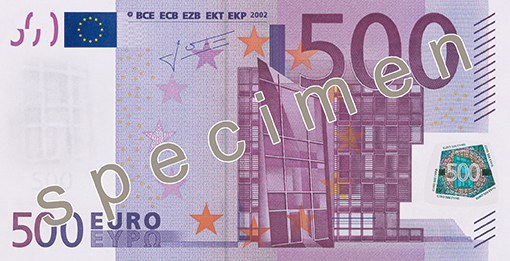
First-series 500 euro: no longer produced since 27 April 2019, but still legal tender and exchangeable at any euro-area national central bank.
Withdrawal and exchange
The word “withdrawal” can be confusing. In banknote history, it can mean that a central bank is replacing an older design, removing unfit notes from circulation, or announcing that a note or series will eventually cease to circulate.
For euro banknotes, the official message is deliberately reassuring. The ECB says first-series notes retain their value, and it says the 500 euro note can be exchanged at any national central bank in the euro area at any time.
This differs from old national currencies replaced by the euro. The ECB’s exchange table for former national cash shows that some national central banks still exchange old banknotes without a time limit, while others had deadlines. In Italy, for example, Banca d’Italia records that lire banknotes and coins ceased to have legal tender status after the dual-circulation period in 2002, and the later exchange history followed Italian law.
In other words, old national cash and euro banknotes should not be treated as the same category. A first-series euro note is not an old national-currency note. It is still a euro banknote.
Damaged, stained or suspicious notes
Legal tender status does not mean every physical note is automatically usable in every condition. Damaged, ink-stained, mutilated or suspicious banknotes are handled under specific procedures.
The ECB explains that national central banks replace accidentally damaged euro banknotes when certain conditions are met, for example where more than half of the note is presented or the missing part can be shown to have been destroyed. Intentionally damaged notes are treated differently.
Ink-stained notes require particular caution. The ECB warns that notes clearly stained by anti-theft devices should not be accepted, because they may come from criminal activity. If such a note has already been accepted, the guidance is to take it to a bank or national central bank and explain how it was received.
For collectors, this is an important boundary. Face value, legal tender status, condition, provenance and authenticity are separate questions. A careful description should not collapse them into one claim.
Issuance and value are two questions
When studying a euro banknote, it helps to separate four questions:
- Which series does it belong to?
- Which denomination is it?
- Is it genuine and in acceptable condition?
- What do official sources say about its current status and exchange?
That order avoids two common mistakes. The first is assuming that an old-looking euro note is no longer valid. The second is assuming that legal tender status removes the need to check authenticity, condition and context.
A first-series euro banknote may be older, less common in daily use and interesting to collectors, while still retaining its value. The 500 euro note may no longer be issued, while still belonging to the monetary history and legal framework of the euro. The end of issuance and the end of value are not the same event.

