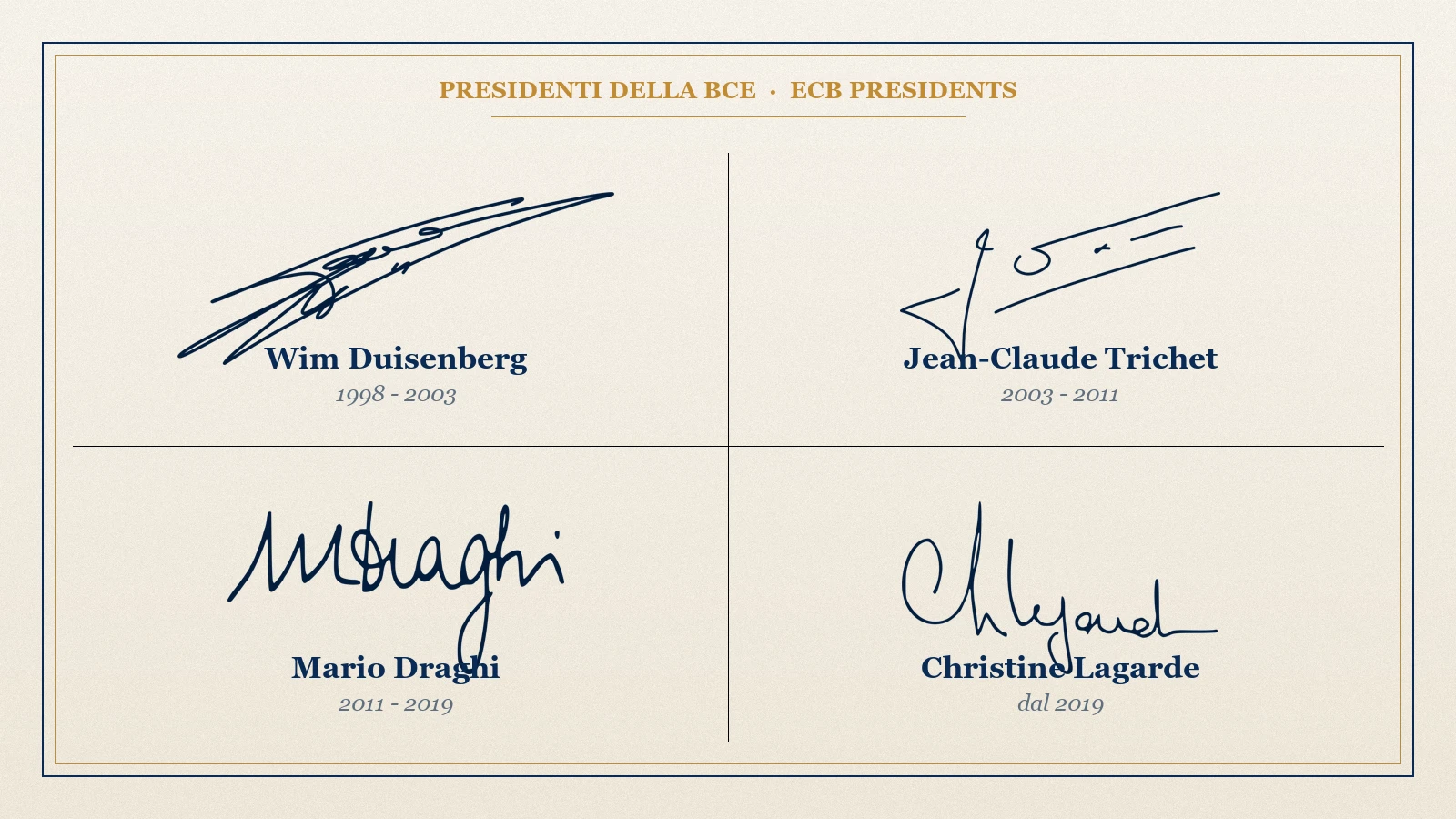
Every euro banknote carries the signature of a President of the European Central Bank. It is a small detail, but it turns a banknote into a historical object: the same design can belong to a different moment depending on the signature printed on it.
The signature should not be confused with a national mark, a printer code or a guarantee of rarity. It identifies the ECB presidency associated with that version of the note. For collectors, it is one of the cleanest ways to organise variants across the first series and the Europa series.
President, not governor
In Italian collecting language, it is common to hear these signatures discussed as the signatures of the “governatori”. In official ECB English, the office is President of the European Central Bank.
This distinction is useful because euro banknotes are not national banknotes. They are issued within the Eurosystem and share a common design. A signature from Wim Duisenberg, Jean-Claude Trichet, Mario Draghi or Christine Lagarde is therefore not a national signature. It belongs to the institutional layer of the euro.
The ECB states that euro banknotes may bear any of these signatures and that all of them are equally valid. A Duisenberg note, a Trichet note, a Draghi note and a Lagarde note can all remain legal tender if the banknote itself is genuine and still accepted under the rules applying to euro banknotes.
The four signatures
Since euro banknotes entered circulation in 2002, four ECB Presidents have signed them.
| President | Signature | Term at the ECB | First series | Europa series |
|---|---|---|---|---|
| Wim Duisenberg |  | 1 June 1998 - 31 October 2003 | Yes | No |
| Jean-Claude Trichet |  | 1 November 2003 - 31 October 2011 | Yes | No |
| Mario Draghi |  | 1 November 2011 - 31 October 2019 | Yes | Yes |
| Christine Lagarde |  | Since 1 November 2019 | No | Yes |
The table gives the broad series-level picture. It does not mean that every denomination, printer, country-letter or production-code combination exists for every signature.


The four ECB Presidents whose signatures have appeared on euro banknotes since 2002.
First series: Duisenberg, Trichet and Draghi
The first series entered circulation on 1 January 2002 under Willem Frederik Duisenberg, known as “Wim”, a Dutchman born in Heerenveen on 9 July 1935 and who died on 31 July 2005. The first President of the ECB, in office from 1 June 1998, he was already at the helm before cash arrived: every banknote issued up to the end of his term, on 31 October 2003, carries his signature.
Jean-Claude Trichet, born in Lyon on 20 December 1942, succeeded Duisenberg on 1 November 2003 and held office for eight years, until 31 October 2011. He signed only first-series banknotes, because the Europa series had not yet entered circulation during his presidency; with the imminent arrival of the Europa 5 euro note (2 May 2013), he is also the last President to have signed a first-series 5 euro note.
Mario Draghi, born in Rome on 3 September 1947, is the transition figure. He became ECB President on 1 November 2011 and was in office when the Europa series was introduced. He is the only President to have signed both first-series banknotes (except the 5 euro denomination) and Europa-series banknotes.
The first-series signature combinations can be read in a useful collector-oriented way:
| First-series denominations | Duisenberg | Trichet | Draghi | Lagarde |
|---|---|---|---|---|
| 5 euro | Yes | Yes | No | No |
| 10, 20, 50, 100, 200 and 500 euro | Yes | Yes | Yes | No |
This is the kind of distinction that matters to collectors: not because a signature automatically creates value, but because it helps identify where a note sits within the chronology of production and replacement.
Europa series: Draghi and Lagarde
The Europa series was launched in 2013 with the new 5 euro note and completed on 28 May 2019 with the new 100 and 200 euro notes. All of that happened during Mario Draghi’s presidency.
Christine Madeleine Odette Lallouette, married name Lagarde, was born in Paris on 1 January 1956 and became ECB President on 1 November 2019, after the Europa series had already been completed as a set (the last denominations, 100 and 200 euro, had entered circulation on 28 May 2019). Her signature therefore belongs to later production of Europa-series notes rather than to the launch of a new denomination.
This makes the Lagarde signature historically interesting for a different reason. It is the first signature of a woman to appear on euro banknotes, and it appears on the current series rather than on a separate third series.

The signatures of Mario Draghi and Christine Lagarde, the two ECB Presidents whose signatures appear on Europa-series banknotes.
A signature is not a date stamp
The signature helps place a banknote in a broad institutional period, but it is not the same as a precise issue date.
A note signed by one President can remain in circulation long after that presidency has ended. First-series notes are also still legal tender and retain their value, even though the Europa series is the only series currently being produced.
For this reason, signatures work best when combined with other evidence: series, denomination, serial number, short production code, printer, condition and documented issuing history.
A small mark with historical weight
For a normal user, the signature is easy to overlook. For a collector, it creates a clean classification line. A 20 euro note can be understood not only by denomination and series, but also by the ECB President whose signature it carries.
This is useful because euro banknotes deliberately avoid national portraits and national monuments. The signature is one of the few personal traces on a design that otherwise speaks in shared European symbols: windows, gateways, bridges, maps, acronyms and security features.
The signature also connects the banknote to ECB history. Duisenberg belongs to the launch of euro cash. Trichet belongs to the long first-series circulation period. Draghi belongs to the transition into the Europa series. Lagarde belongs to the current Europa-series production and to the first female signature on euro banknotes.
The limits of a signature clue
As with serial numbers, signatures should be interpreted soberly. A signature can help identify a variant, but it does not authenticate the note or establish its originality by itself. It also does not automatically make a note rare or valuable.
A signature is most useful when it is read together with the rest of the note: the series tells which Presidents are even possible, the denomination narrows the production window further, and condition and provenance remain the questions that decide whether a note is worth attention.


.jpg)

