
The 500 euro note is one of the most recognisable absences in the current euro banknote system.
It was part of the first series introduced in 2002. It was the highest denomination, the largest note, the violet note, the one linked to modern architecture. Yet it did not continue into the Europa series, and it has not been issued by Eurosystem central banks since 2019.
That makes it easy to misunderstand. The 500 euro note is no longer issued, but it has not been cancelled. It remains part of euro banknote history, it remains legal tender, and it retains its value.
A first-series denomination
The first euro banknotes entered circulation on 1 January 2002 as a set of seven denominations: 5, 10, 20, 50, 100, 200 and 500 euro. The 500 euro note was therefore not a later exception. It belonged to the original architecture of the euro.
In the design system of the first series, each denomination had its own colour and architectural period. The 500 euro note was violet and represented modern 20th-century architecture. Like the other first-series notes, it showed windows or gateways on the front and a bridge on the back, following the “Ages and styles of Europe” theme.
It was also physically the largest euro banknote: 160 x 82 mm. The height matched the 100 and 200 euro notes, but the width continued the progressive increase by denomination.
| Feature | 500 euro note |
|---|---|
| Series | First series only |
| First circulated | 1 January 2002 |
| Size | 160 x 82 mm |
| Dominant colour | Violet |
| Architectural style | Modern 20th-century architecture |
| Known first-series signatures |
For collectors, those details matter. The 500 euro note is not simply a large-value payment instrument. It is the closing denomination of the original seven-note set.
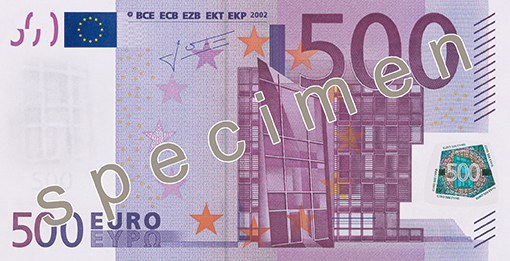
First-series 500 euro: the highest denomination ever issued in the euro cash system, still legal tender though no longer printed.
No 500 euro note in the Europa series
The Europa series was introduced gradually between 2013 and 2019. It kept the familiar denomination sequence up to 200 euro, but it did not include the 500 euro note.
On 4 May 2016, the ECB announced that its Governing Council had decided to permanently stop producing the 500 euro banknote and to exclude it from the Europa series. The decision was framed as a production and issuance decision, not as a cancellation of value.
The ECB’s press release stated that the decision followed concerns that the denomination could facilitate illicit activities. That point is part of the official history and should not be ignored. At the same time, it should not become the whole story. The banknote also belongs to the wider evolution of euro cash: the redesign of the series, the strengthening of security features and the decision to simplify the current set of denominations.
The end of issuance
The end of the 500 euro note happened in stages. The ECB decision was announced in 2016, while issuance continued for a period so that the transition could be managed.
Most Eurosystem national central banks stopped issuing 500 euro notes on 26 January 2019. The Deutsche Bundesbank and the Oesterreichische Nationalbank continued issuing them until 26 April 2019 for logistical reasons. The ECB currently describes the 500 euro banknote as no longer issued since 27 April 2019.
| Date | What changed |
|---|---|
| 1 January 2002 | The 500 euro note enters circulation with the first euro banknotes. |
| 4 May 2016 | The ECB announces the decision to stop producing and issuing it. |
| 26 January 2019 | Most Eurosystem national central banks stop issuing 500 euro notes. |
| 26 April 2019 | Germany and Austria complete the extended issuance period. |
| 27 April 2019 | The 500 euro note is no longer issued by the Eurosystem. |
This timeline is useful because it avoids a common false shortcut. A note can stop being issued on a specific date while still remaining a valid euro banknote after that date.
Legal tender and exchange value
The ECB states that 500 euro notes remain legal tender and will always retain their value. They can also be exchanged at national central banks of the Eurosystem for an unlimited period.
Banca d’Italia gives the same practical message in its public guidance: the 500 euro banknote remains legal tender, can continue to be used as a means of payment and store of value, and can be changed at Eurosystem national central banks without time limit.
This does not mean that every payment situation is frictionless. A very high-value banknote may raise practical issues in everyday retail: availability of change, proportionality to the purchase, internal cash policies, anti-money-laundering procedures or checks by professional cash handlers. Those are practical and legal-context questions, not proof that the banknote has lost its face value.
For a fuller treatment of acceptance, exchange and damaged notes, the companion article on legal tender, withdrawal and exchange is the better starting point.
Design, rarity and perception
The 500 euro note attracts attention partly because it sits at the edge of ordinary cash experience. Many people in the euro area have used 5, 10, 20 and 50 euro notes regularly. Far fewer have handled a 500 euro note in daily life.
That difference changes perception. A note can be legal tender, official and valid, while still feeling unusual. The 500 euro note is a good example: its high face value, violet colour, large format and disappearance from new issuance make it more memorable than many circulating denominations.
In collecting terms, the first questions remain ordinary ones. Which signature does it carry? Which serial-number prefix and printer code are present? What is its condition? Is it genuine? Does it have provenance or a particular production context worth recording?
Those questions are more useful than treating the note as a rumour object. The 500 euro banknote is interesting enough without exaggeration.
Security features in context
The 500 euro note belongs to the first series, so its security language is the first-series security language: raised print, watermark, security thread, see-through number, hologram, colour-changing number and other machine-readable and specialist features.
The public method remains the familiar ECB sequence: feel, look and tilt. For the 500 euro note, as for any other denomination, a single sign should never be treated as proof by itself. Authenticity is a combined judgement based on the note, its features, its condition and the circumstances in which it is examined.
Banknotes.eu keeps this distinction deliberately. The 500 euro note is worth studying, but an article about it should not become a counterfeit manual. For the security system itself, see the article on first-series security features.
A boundary note in euro history
The 500 euro note marks a boundary between two moments of the euro.
On one side is the original 2002 set: seven denominations, one visual programme, one coordinated launch. On the other side is the Europa series: a redesigned, more secure six-denomination system without the highest value.
That boundary gives the note its place. It is no longer part of current issuance, but it is still part of the euro’s legal and visual history. It shows how a currency can change its active design without erasing what came before.

