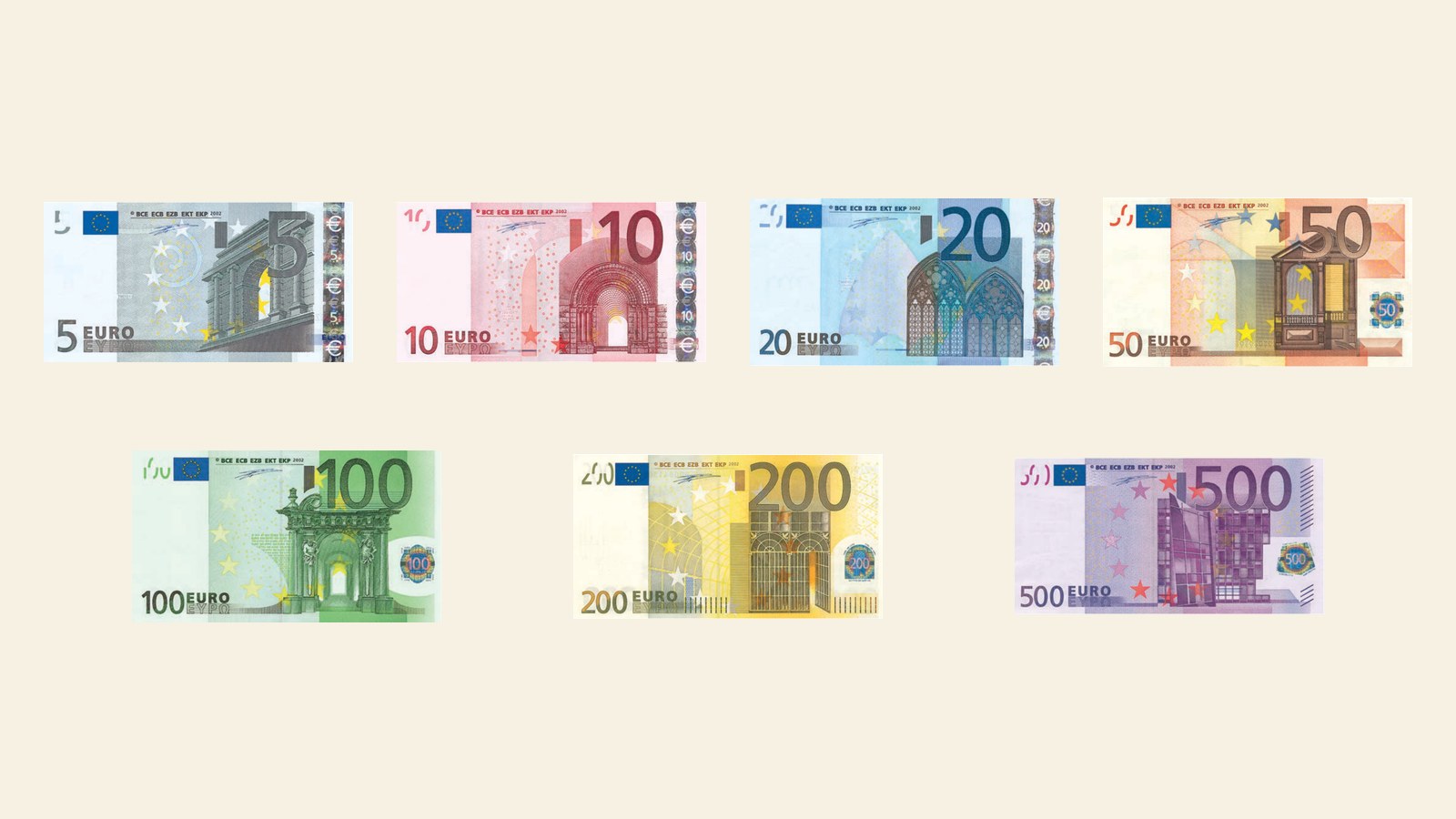
The seven first-series banknotes launched together on 1 January 2002 and look deliberately alike, but their production records differ sharply: fourteen printing works for the 20 euro against five for the 500, three presidential signatures on most denominations and only two on the 5. Each has its own page below, over 1,156 documented runs in total.
Choose a denomination
 5 euro121 runs · Classical
 10 euro204 runs · Romanesque
 20 euro336 runs · Gothic
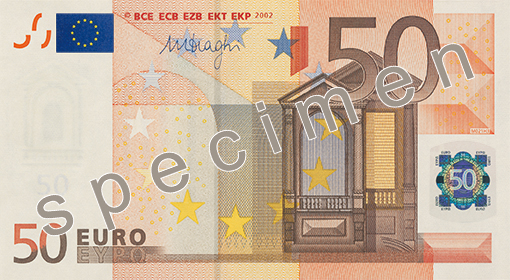 50 euro356 runs · Renaissance
 100 euro88 runs · Baroque and rococo
 200 euro20 runs · Iron and glass
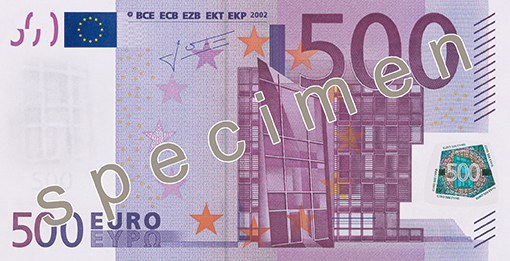 500 euro31 runs · Modern
What each row records
Every entry keeps the fields that let one documented run be compared with another: the country and its code, the signature as catalogued, the printing year, the printer letter and printing works, the plate run, the sheet format and numbering, a rarity grade and a reference price. The original source rows, source URLs and the proprietary mnemonic code were removed before the extract was prepared, and incomplete records were excluded.
The issue year is always 2002. The year printed can be much later, and that distinction carries most of the chronological information in the table: it separates the common launch date of the series from the batches that kept cash in circulation as the euro area grew from twelve members to nineteen.
The country column and the printer column answer different questions. In the first series the country letter belongs to the long serial number and points to the national central bank associated with the issue; the letter in the short production code identifies the works that ran the plates. Italy is the clearest example, with S in the serial logic and J in the printer-code system. The printer-code guide sets out that distinction in full.
Where the identification code sits
The first series hides the short production code somewhere different on each denomination, always on the front and always inside the offset-printed design. The 50 and 500 euro positions below were checked against certified Cartamoneta.com scans — J002F2 sits just above the hologram patch on the 50, and J001G… on the middle left-hand star of the 500.
| Denomination | Where to look on the front | Sheet positions |
|---|---|---|
| 5 € | Left edge of the printed design, about a centimetre above the O of EURO | A1 – J6 |
| 10 € | First star at the upper right, on the diagonal of the O of EURO | A1 – I6 |
| 20 € | Second star at the upper right, about two centimetres from the O of EURO | A1 – I6 |
| 50 € | Immediately above the hologram patch | A1 – H5 |
| 100 € | Over the first word of the text between the portal and the stars | A1 – H5 |
| 200 € | Right of the lower-left star, set vertically | A1 – H5 |
| 500 € | Middle star of the left-hand group | A1 – G4 |
The sheet ranges are the Banca d’Italia layouts documented in the Cartamoneta catalogue; other printing works used sheets of their own, so a position outside these ranges is not automatically wrong. The Europa series ended the guessing game: from 2013 the code sits top right on every denomination, set vertically beside the holographic stripe.
How rarity and quotation are worked out
The rarity grade uses the scale printed in the Cartamoneta catalogue: C3 (extremely common), C2, C, NC, then R through R5 for the genuinely scarce. The two grades reserved for editorial judgement — U for a unique example and NR for a note known only from the literature — are never derived here. It is calculated from how far a documented run sits above the ordinary level for its own denomination, not from an absolute multiple of face value. That difference matters: an ordinary first-series 5 euro is already catalogued at several times its face value, while an ordinary 500 euro barely exceeds it, so a single threshold applied across all seven denominations would grade almost every small note as rare and almost every large one as common.
Where the catalogue gave a rarity code instead of a price, Gerardo Vendemia has now set the figure by hand, so the first series is priced in full. A few Europa-series runs remain unpriced; for those the tables show the catalogue’s own grade in italics with the quotation left empty, because quoting a figure would suggest a market that does not exist for a run known from a handful of examples.
Every price shown is for one condition only: gem uncirculated, GEM-UNC, the top of the grading scale. It is the Cartamoneta.com reference — the catalogue figure with the mark-up published for that denomination, rounded up to the next step. Above a threshold set per denomination (€500 on the 5 euro, €750 on the 10, €1,000 on the 20, €1,500 on the 50, €1,750 on the 100) the mark-up gives way to a 10% reduction; the 200 and 500 euro are never reduced. A circulated banknote is worth less, often far less. The figure is an indicative reference and not an offer or a valuation of a particular banknote.
What the catalogue cannot settle
Catalogues are at their most useful when they let a reader ask a sharper question: which documented run is this, which works is associated with it, and which details deserve a second look? They do not replace the ordinary security checks, and they do not settle authenticity.
For the physical examination, start with the first-series security features and the serial-number guide, then come back to the denomination page to place the note in its production context.