Euro banknotes are issued by the European Central Bank and have been in circulation since 1 January 2002. For most citizens, this was the moment when the euro stopped being mainly a financial and accounting reality and became something visible, tangible and ordinary: cash in a wallet, change from a shop, notes from an ATM.
The launch was not only a monetary event. It was a logistical, cultural and visual event. Twelve countries changed the cash used in daily life, and the first euro banknotes had to be accepted immediately by millions of people who were used to national currencies with their own faces, symbols and habits.
From virtual currency to everyday money
The euro began on 1 January 1999 as the single currency for financial markets, bank accounts and electronic payments. Cash came later. For three years, the euro existed for many people as a price, a conversion rate or a bank statement, while national banknotes and coins still circulated in shops and households.
That delay was necessary. Producing a new shared currency meant deciding the denominations, designing banknotes that avoided national preference, printing billions of notes, minting coins, preparing banks and retailers, adapting cash machines and explaining the change to the public.
ECB changeover material describes this as a long process: from the drawing board to printing works, from central banks to citizens’ wallets. That is the right way to understand the 2002 launch. The notes did not simply appear; they arrived after years of preparation.
The 12-country launch
The first cash changeover took place in twelve countries: Austria, Belgium, Finland, France, Germany, Greece, Ireland, Italy, Luxembourg, the Netherlands, Portugal and Spain.
| Changeover fact | What happened |
|---|---|
| Launch date | Euro banknotes and coins entered circulation on 1 January 2002. |
| Countries | 12 original euro-area cash-changeover countries. |
| Population | The ECB gives a total population of 308 million people. |
| Early distribution | Euro cash was distributed to banks and retailers from September 2001. |
| ATM conversion | By 3 January 2002, 96% of euro-area cash dispensers were issuing euro banknotes. |
| Dual circulation | National cash and euro cash circulated together for a short period, lasting up to two months in some countries. |
By 1 March 2002, after the dual circulation period had ended, the euro had become the sole legal tender in the euro area. The ECB records that by then more than 6 billion national banknotes and close to 30 billion national coins had been withdrawn.

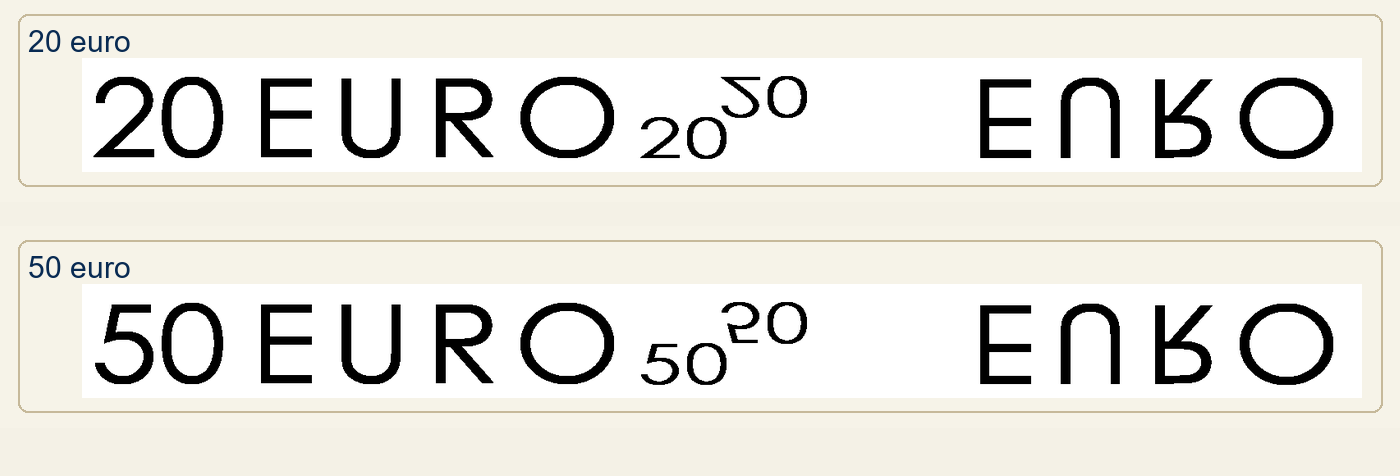
First-series 20 euro: the most common denomination in everyday use following the 2002 launch.
The euro area grew over time
The twelve countries of 2002 did not stay the only ones. In the following years, other EU member states adopted the euro: Slovenia from 1 January 2007, Cyprus and Malta from 2008, Slovakia from 2009, Estonia from 2011, Latvia from 2014, Lithuania from 2015, Croatia from 2023 and Bulgaria from 2026. Each new entry extended the same shared banknote system to another country, without changing the common design introduced in 2002.
A design built for many countries
The first euro banknotes had to work in a politically delicate space. They had to feel European without giving one country, monument or historical figure a privileged place.
That is why the first series used the theme usually known as “Ages and styles of Europe”. The front of the notes shows windows and gateways; the back shows bridges. The images are symbolic, not reproductions of real monuments.
This decision gave the banknotes a neutral shared language. A portrait could have raised questions of nationality. A famous building could have seemed to belong to one city. Windows, gateways and bridges suggested openness, communication and connection without becoming a national catalogue.
Robert Kalina, designer of the first series
The winning design was produced by the Austrian banknote designer Robert Kalina, who had worked for the Oesterreichische Nationalbank since 1976 and had already designed numerous banknotes for the institution.
His sketches prevailed over those of 43 other competitors in the 1996 competition and were announced as the winner on 3 December that year. More than 300 designs from across Europe were considered. The proposal organised the seven denominations as a journey through seven periods of European architecture, from the Classical world to the twentieth century. Windows and gateways on the front represent openness and cooperation; bridges on the back stand for communication among Europe’s people and between Europe and the rest of the world.
The seven denominations
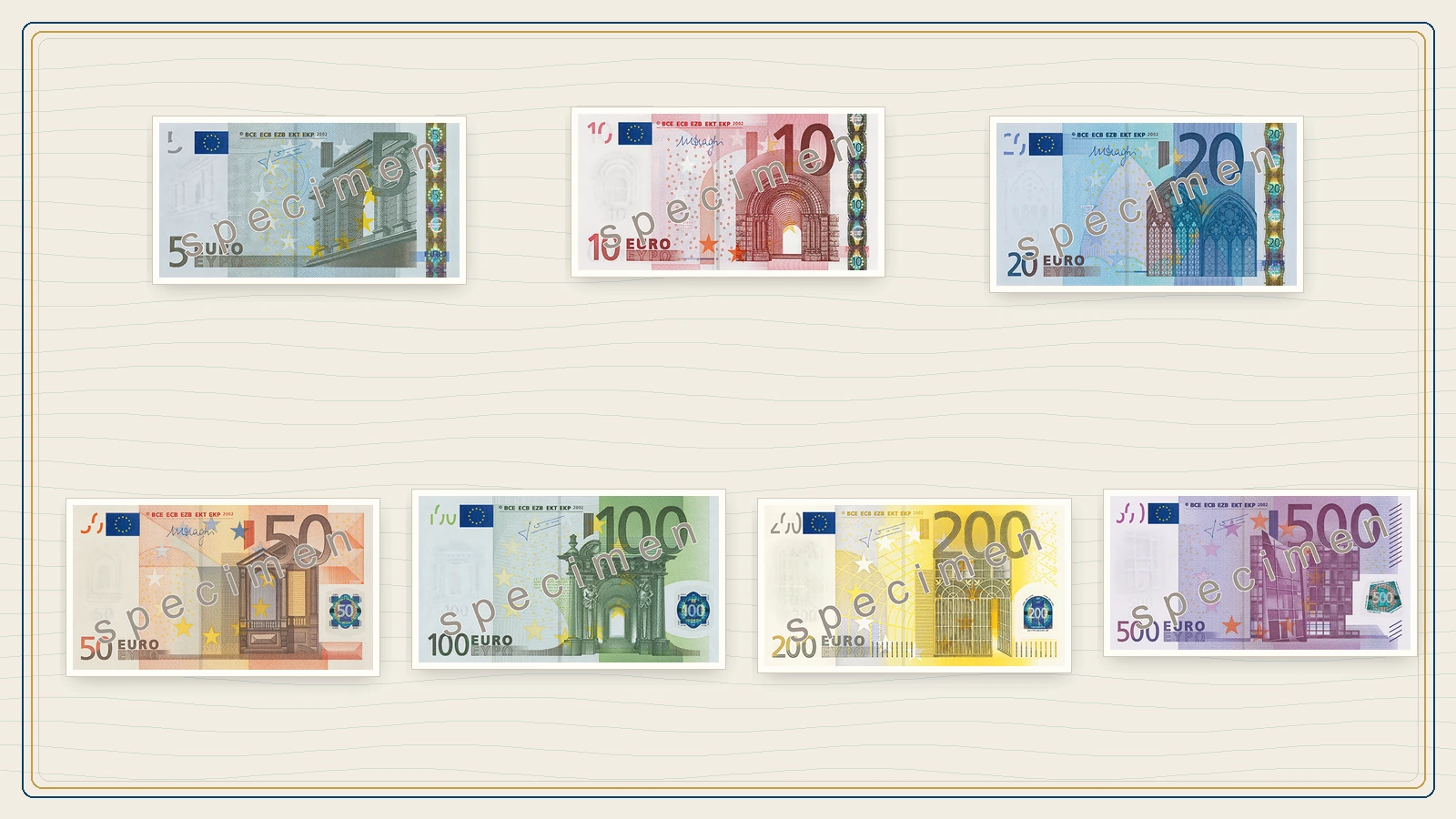
All seven first-series denominations entered circulation on 1 January 2002: 5, 10, 20, 50, 100, 200 and 500 euro.
| Denomination | First circulated | Dominant colour | Architectural period | First-series size |
|---|---|---|---|---|
 5 euro 5 euro | 1 January 2002 | Grey | Classical | 120 x 62 mm |
 10 euro 10 euro | 1 January 2002 | Red | Romanesque | 127 x 67 mm |
| 20 euro | 1 January 2002 | Blue | Gothic | 133 x 72 mm |
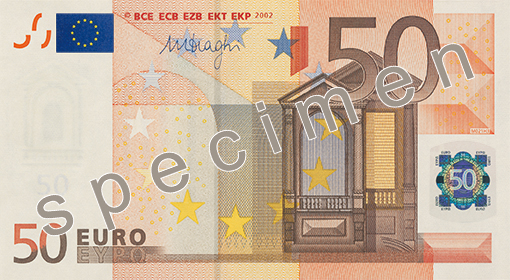 50 euro 50 euro | 1 January 2002 | Orange | Renaissance | 140 x 77 mm |
 100 euro 100 euro | 1 January 2002 | Green | Baroque and rococo | 147 x 82 mm |
 200 euro 200 euro | 1 January 2002 | Yellow-brown | 19th-century iron and glass architecture | 153 x 82 mm |
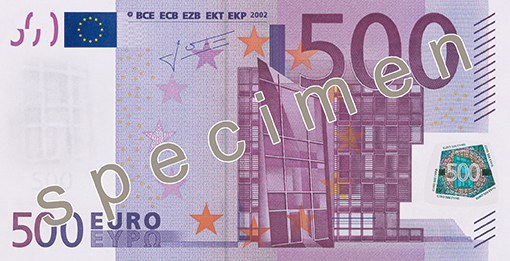 500 euro 500 euro | 1 January 2002 | Purple | Modern 20th-century architecture | 160 x 82 mm |
Colour helped people recognise each denomination, while width and height increased with value until the 100, 200 and 500 euro notes reached a common height of 82 mm.
The first series also had to function across languages. The name of the currency appeared as EURO and EYPΩ, using Latin and Greek alphabets. The initials of the European Central Bank appeared in five variants: BCE, ECB, EZB, EKT and EKP.
The scale of production
The 2002 cash changeover required a huge stock of physical money before the launch date. The ECB states that production of euro banknotes began in July 1999 and involved 15 printing works across the European Union.
By 1 January 2002, an initial supply of 14.89 billion banknotes had been printed for the 12 countries, including logistical stocks. Around 52 billion coins were also produced by 16 European mints.
This explains why the changeover was more than a matter of design. A banknote only becomes money in daily life when the whole system around it works: printing, storage, transport, cash machines, banks, shops, public information and withdrawal of old cash.
A change felt in daily life
For ordinary people, the changeover compressed years of institutional preparation into a few practical gestures. Prices had to be read in a new unit. National notes and coins had to be exchanged or spent during the transition. Retailers had to give change in euro. ATMs had to switch quickly.
The first days mattered because trust depended on everyday usability. If people could withdraw euro banknotes, pay with them, receive change and recognise the denominations, the new currency would become familiar very quickly.
The ECB’s changeover data suggests that this happened with remarkable speed: one week after the introduction, more than half of all cash transactions were already in euro.
The 2002 notes as a reference point
The first series is no longer the current production series. From 2013 to 2019 it was gradually replaced by the Europa series, which updated the design and introduced new security features.
But the first series remains central to the story of the euro. It is the series that people first touched. It is the design that introduced the windows, gateways, bridges and denomination colours. It is also the series that includes the 500 euro note, a denomination not continued in the Europa series.
For collectors and readers, the 2002 banknotes are the starting point for almost every later topic: security features, signatures, serial numbers, printer codes, legal tender, the Europa redesign and the future banknote series.
That is why the 2002 launch is more than a date at the beginning of a timeline. It is the moment when the euro became a physical habit, and the point from which the later stories of design, security, signatures, serial numbers and replacement series all begin.