Serial numbers are among the most familiar details on euro banknotes, but they are also among the easiest to misread. They look like a simple identifier, yet they can reveal something about the note’s production system, the issuing logic of the first series and the printer-code logic of the Europa series.
They should be read with care. A serial number is not a certificate of authenticity, and it does not automatically make a banknote rare. It is a clue: useful when combined with series, denomination, signature, printer code, condition and verified source data.
First, do not confuse two codes
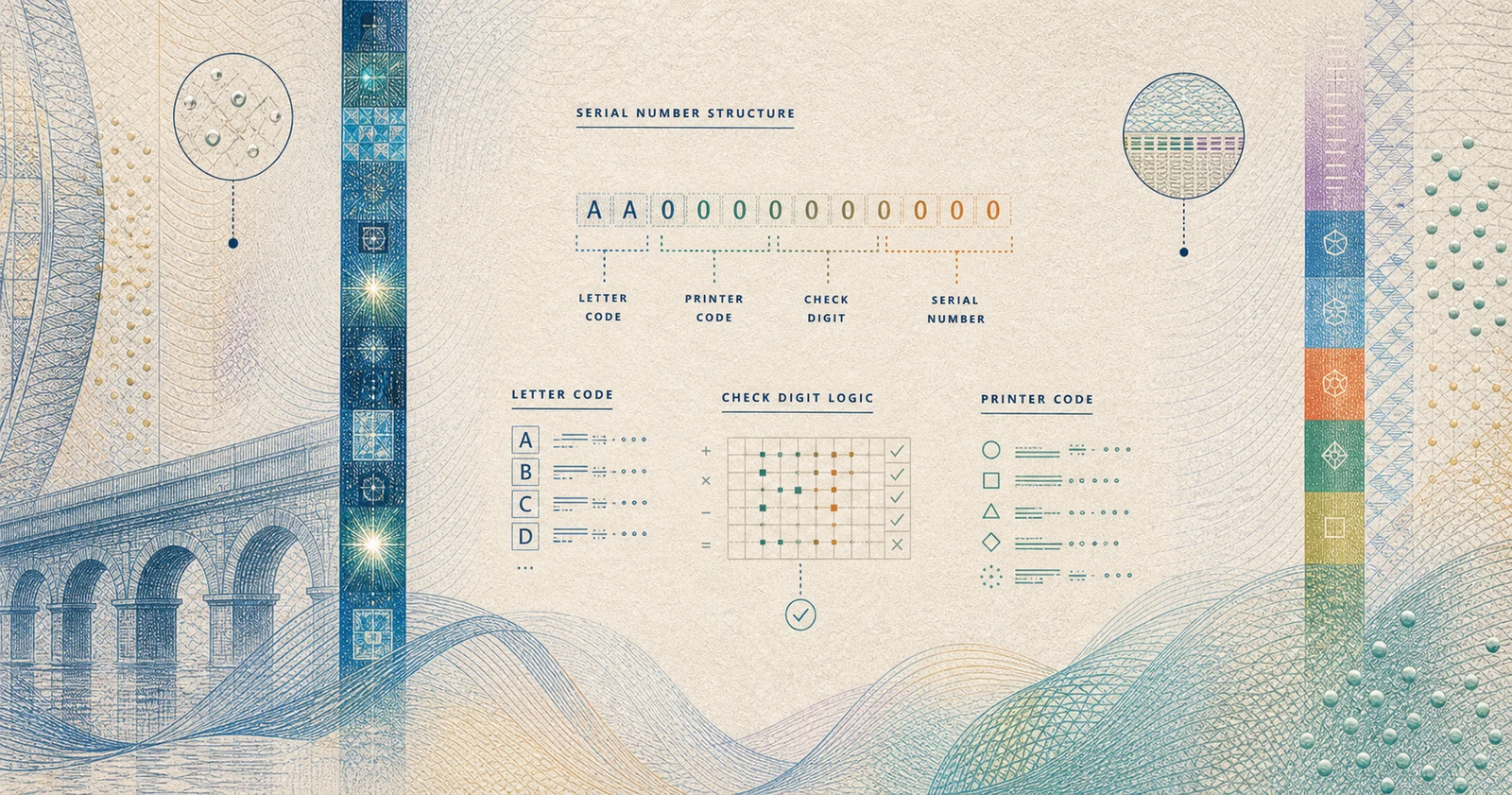
Euro banknotes have a visible serial number, but they also have a short production code. The two are related to production history, but they are not the same thing.
The serial number is the long code most people notice first. On first-series banknotes it begins with one letter followed by eleven digits. On the Europa series it begins with two letters followed by ten digits.
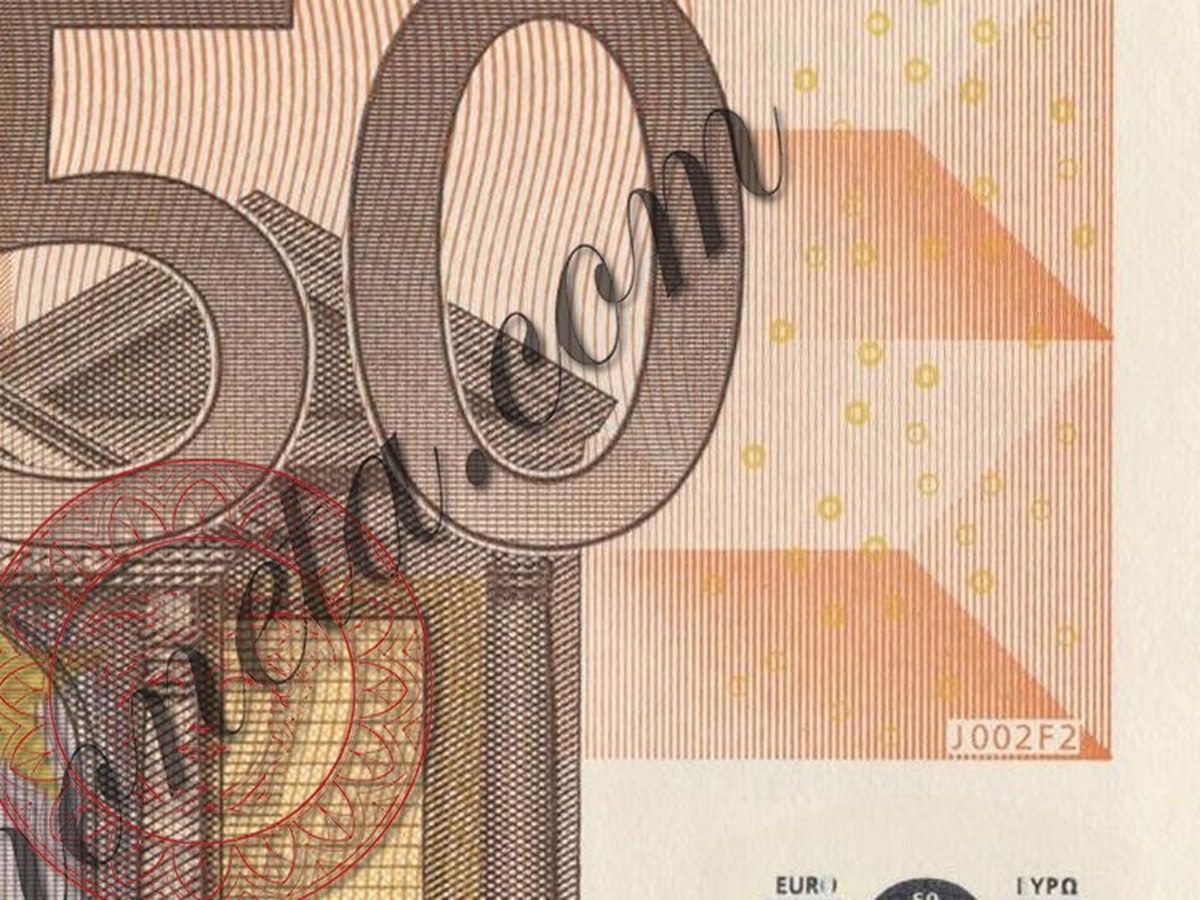
The production code is shorter. It identifies the printing works, the printing plate and the position of the note within the printed sheet. A simple first-series example is J001A1: J for the printing works, 001 for the printing plate, and A1 for the sheet position.
First series: one letter and eleven digits
In the first series, the serial number has the form:
S02896734778
The first letter is often described as a national letter. It points to the national central bank that commissioned the banknote, not necessarily to the country where the note was physically printed. This distinction matters because euro banknotes are produced through a coordinated Eurosystem process: printing works can produce notes for central banks other than their own country.
For example, Italy is associated with the letter S in the first-series serial-number system. That does not mean every note with an Italian national letter should be reduced to a simple “made in Italy” label. The printing works may be identified separately by the short production code.
The source spreadsheets also assign a numerical value to each letter. In this system A corresponds to 11, B to 12, and so on up to Z as 36, with some letters unused or reserved. Italy’s S corresponds to 29.
The full first-series national-letter table, reconstructed from the source spreadsheet, is:
| Letter | Value | Country | Control digit | Notes |
|---|---|---|---|---|
Z | 36 | Belgium | 9 | — |
Y | 35 | Greece | 1 | — |
X | 34 | Germany | 2 | — |
W | 33 | Denmark | 3 | Not used (Denmark has not adopted the euro) |
V | 32 | Spain | 4 | — |
U | 31 | France | 5 | — |
T | 30 | Ireland | 6 | — |
S | 29 | Italy | 7 | — |
R | 28 | Luxembourg | 8 | Printed by other Eurosystem printing works on Luxembourg’s behalf |
Q | 27 | — | — | Unassigned (avoided as a digit lookalike) |
P | 26 | Netherlands | 1 | — |
O | 25 | — | — | Unassigned (avoided as a digit lookalike) |
N | 24 | Austria | 3 | — |
M | 23 | Portugal | 4 | — |
L | 22 | Finland | 5 | — |
K | 21 | Sweden | 6 | Not used (Sweden has not adopted the euro) |
J | 20 | United Kingdom | 7 | Not used (UK never adopted the euro) |
I | 19 | — | — | Unassigned (avoided as a digit lookalike) |
H | 18 | Slovenia | 9 | Euro adopted 2007 |
G | 17 | Cyprus | 1 | Euro adopted 2008 |
F | 16 | Malta | 2 | Euro adopted 2008 |
E | 15 | Slovakia | 3 | Euro adopted 2009 |
D | 14 | Estonia | 4 | Euro adopted 2011 |
C | 13 | Latvia | — | Euro adopted 2014 |
B | 12 | Lithuania | — | Euro adopted 2015 |
A | 11 | — | — | Unassigned |
The control digit is the value used in the checksum operations described in the checks below. The “not used” entries belong to letters reserved for countries that never adopted the euro but that were kept in the original scheme.

First-series 50 euro, Duisenberg signature, Italian letter S,
serial S02896734778.
Europa series: two letters and ten digits
The Europa series changes the structure:
SF1000128204
Here the serial number starts with two letters and then ten digits. The first letter is linked to the printing works. This is one of the important shifts from the first series: the letter at the beginning is no longer best read as the same kind of national-letter clue used on the original 2002 banknotes.
The second letter helps extend the numbering system and is also used in serial-number arithmetic. In the example above, S indicates the Banca d’Italia printing works in the Europa-series system, while F is part of the serial structure.
The Europa series also repeats the serial information differently on the back of the note: the full serial number appears horizontally, while a shorter vertical repeat shows the final digits in a different orientation and colour.

Europa-series 20 euro, Draghi signature, full serial SF1000128204
horizontally and the short vertical repeat 128204.
One letter, different questions
The most useful way to remember the change is this:
| Series | Serial format | First letter mainly tells you | Separate production code |
|---|---|---|---|
| First series | 1 letter + 11 digits | The national central bank associated with the issue. | Present as a short code such as |
| Europa series | 2 letters + 10 digits | The printing works associated with the note. | Still present, but the first letter follows the updated printer-code logic. |
Serial numbers are therefore a good bridge between ordinary observation and collector-level study. They are visible to everyone, but they become meaningful only when the series is identified correctly.
The control check
The serial number also contains a simple numerical curiosity often discussed by collectors. It is useful as a consistency check, but it should never be treated as proof that a banknote is genuine.
For a first-series Italian example such as S02896734778, the eleven digits can be added:
0 + 2 + 8 + 9 + 6 + 7 + 3 + 4 + 7 + 7 + 8 = 61
Adding the digits of 61 gives 7. In the corresponding first-series control table, the value associated with the Italian letter S is also 7.
Another version of the check uses the letter’s numerical value. Since S corresponds to 29, the serial S00246543181 can be read for this arithmetic purpose as 2900246543181, a number divisible by nine.

First-series 200 euro, Duisenberg signature, serial S00246543181
used here for the divisibility-by-nine variant.
The same national numerical value allows two further checks, which collectors call the “casting out nines” test. In the first, the sum of the previous check result (7 for Italian notes) and the national value (29) is always a multiple of nine: 7 + 29 = 36. In the second, the last digit of the serial works as a check digit: remove it and divide the remaining number by nine, and the difference between nine and the remainder gives back that very digit. These remain arithmetic curiosities, not proofs of authenticity, but they show how much structure was built into the serial number.
For the Europa series, the idea changes because the serial has two letters. The second letter is converted through a different lookup, set out in the source material as a simple letter-to-number mapping that runs the alphabet from A = 2 to Z = 27. The full table is:
| Letter | Value | Letter | Value |
|---|---|---|---|
A | 2 | N | 15 |
B | 3 | O | 16 |
C | 4 | P | 17 |
D | 5 | Q | 18 |
E | 6 | R | 19 |
F | 7 | S | 20 |
G | 8 | T | 21 |
H | 9 | U | 22 |
I | 10 | V | 23 |
J | 11 | W | 24 |
K | 12 | X | 25 |
L | 13 | Y | 26 |
M | 14 | Z | 27 |
Using this table on the example SF1000128204, the second letter F is converted to 7. The calculation becomes:
7 + 1 + 0 + 0 + 0 + 1 + 2 + 8 + 2 + 0 + 4 = 25
Adding 2 + 5 gives 7, again matching the control value associated with the Italian printer letter S.
The lookup is deliberately not the same as the first-series national-letter table, which runs A = 11 to Z = 36. The Europa series uses its own scheme because the second letter of the serial is part of the serial structure, not a national-bank identifier.
Checksum as warning, not proof
A failed control check is a warning sign. It suggests that the serial number does not fit the expected arithmetic pattern.
A successful control check is much weaker. It does not prove that the banknote is genuine, because a number can be constructed to pass a simple check. Authentication still depends on the banknote itself: paper, raised print, watermark, security thread, hologram, colour-shifting elements and, when needed, professional verification.
This is the same caution that applies to many banknote details. A serial number can support an interpretation; it should not carry the whole interpretation alone.
What the serial can and cannot tell you
Collectors study serial numbers because they connect several layers of information. A serial may help place a note within a production logic, distinguish first-series and Europa-series conventions, compare printing works, or understand why two visually similar notes belong to different technical contexts.
The same field also invites mistakes. A national letter is not always a place of manufacture. A printer code is not the same thing as a serial number. A valid checksum is not an authentication certificate. And rarity depends on evidence, not on an unusual-looking code alone.
The companion article on printing offices and printer codes covers the production-code side, which is read on the back of the note and follows different rules.
To decode a specific number, the serial number and printer code checker runs the same arithmetic shown here: paste a serial, and it identifies the series, the letter and its meaning, and reports whether the consistency check matches the source control value.