
Euro banknotes and euro coins belong to the same currency, but they do not follow exactly the same institutional logic.
This is why a euro banknote looks the same wherever it circulates, while a euro coin has one common European side and one national side. The difference is not decorative only. It reflects how responsibilities are divided between the European Central Bank, the national central banks, euro-area countries, the European Commission and national mints.
For readers and collectors, this distinction helps prevent a common misunderstanding: euro coins are not “local money” because they have a national side, and euro banknotes are not issued by one single printing office because they have a common design. Euro cash is shared, but its production and circulation are organised through several institutions.
One euro, two cash routes
The euro is the official currency of the euro area. Euro banknotes and euro coins are legal tender there, but the official framework separates banknotes and coins.
The public-facing division is clear. Legally, both the ECB and the national central banks of the euro area have the right to issue euro banknotes. In practice, however, the national central banks physically issue and withdraw them. For coins, the legal issuers are the euro-area countries, while the European Commission coordinates coin-related matters at euro-area level.
That creates two parallel systems:
| Question | Euro banknotes | Euro coins |
|---|---|---|
| Who has the issuing role? | The ECB and euro-area national central banks have the legal right to issue euro banknotes. | Euro-area countries are the legal issuers of euro coins. |
| Who physically puts cash into circulation? | National central banks issue and withdraw banknotes through the cash system. | Coins are minted and issued through national arrangements within common euro-area rules. |
| Who coordinates the system? | The ECB oversees national central bank activities and harmonises cash services. | The European Commission coordinates coin-related matters; the ECB approves the annual volume and value of coins. |
| What does the public see? | A common banknote design across the euro area. | One common side and one country-specific national side. |
Banknotes move through the Eurosystem
Euro banknotes are a Eurosystem responsibility. The ECB and the national central banks of the euro-area countries form the institutional system behind them.
This does not mean that the ECB runs cash counters or physically distributes notes to the public. The ECB states that it has no cash office and is not involved in cash operations. The practical work of issuing and withdrawing euro banknotes is carried out by national central banks, which put banknotes into circulation through the banking system and, to a smaller extent, the retail industry.
Production is also shared. Since 2002, euro banknotes have been produced jointly by the national central banks. Each national central bank is responsible for a proportion of annual production, often in one or more denominations, and the calculated production volumes are approved by the ECB Governing Council.
That is why the production history of euro banknotes can involve several countries and printing works without changing the basic public fact: the design is common, the currency is common, and the notes circulate throughout the euro area.
Coins leave room for national design
Euro coins work differently. Their national side is not an exception to the euro system; it is part of the system.
Each euro coin has a common side, with the denomination and a European design, and a national side chosen by the issuing country. The European Commission describes this as a standard feature of euro coins: the common side is the same across the euro area, while the national side is country-specific.
The ECB gives the same practical reading: the national side indicates the issuing country, but any euro coin can be used anywhere in the euro area. A 2 euro coin issued by Italy, France, Germany, Spain, Ireland or another euro-area country remains a euro coin, not a coin restricted to that country.
The responsibilities are layered:
- Euro-area countries are responsible for issuing coins.
- National mints physically produce them.
- Distribution follows national arrangements.
- The European Commission coordinates coin-related matters and publishes information on new designs.
- The ECB approves the volume and value of coins to be issued each year.
This structure explains why the coin system can be national in appearance and European in circulation at the same time.
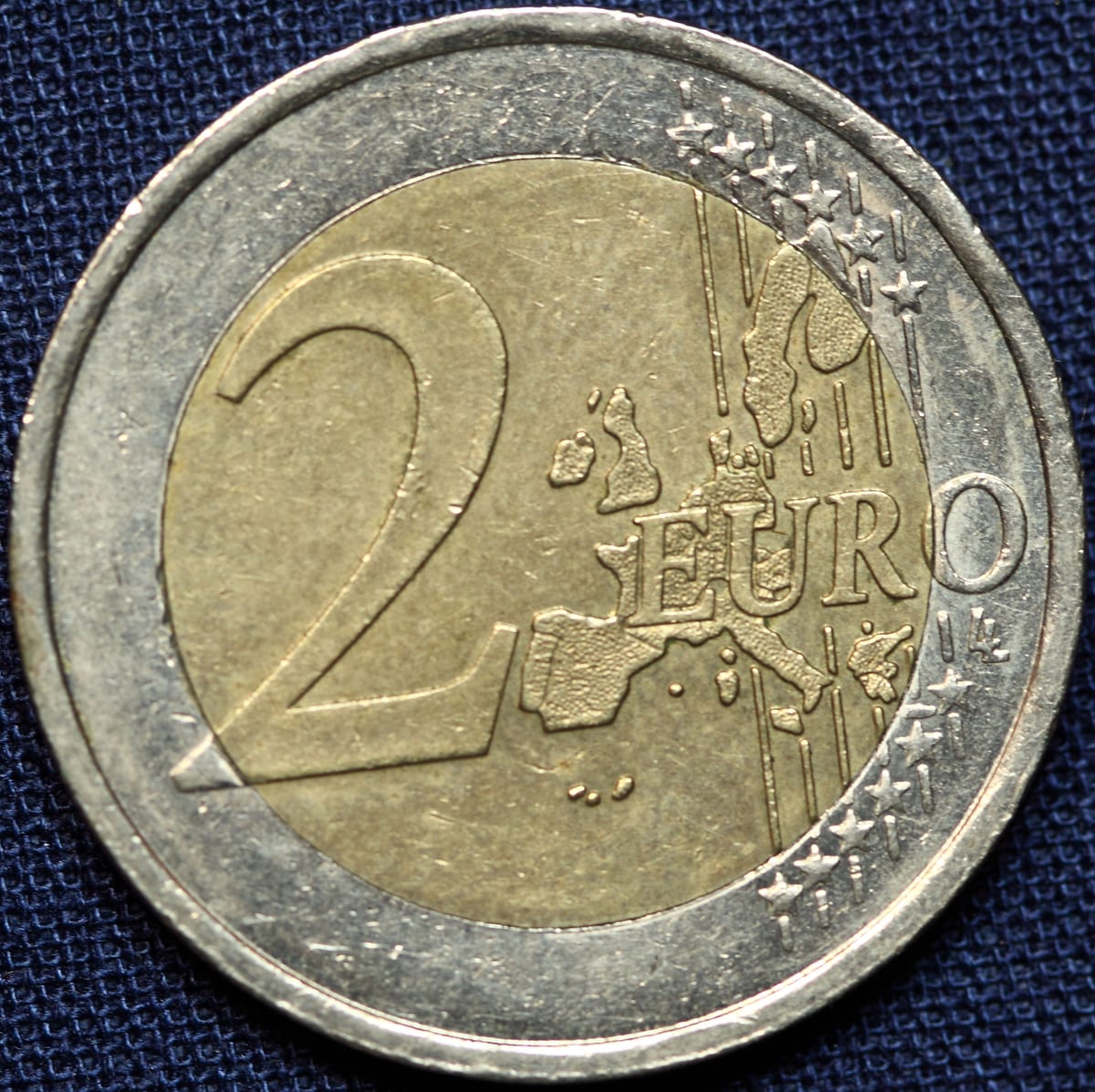
The common side of a 2 euro coin. Every euro coin pairs this common side with a national side; banknotes follow a different rule and share a single design across the euro area.
Why banknotes do not have national sides
The difference between banknotes and coins is visible immediately.
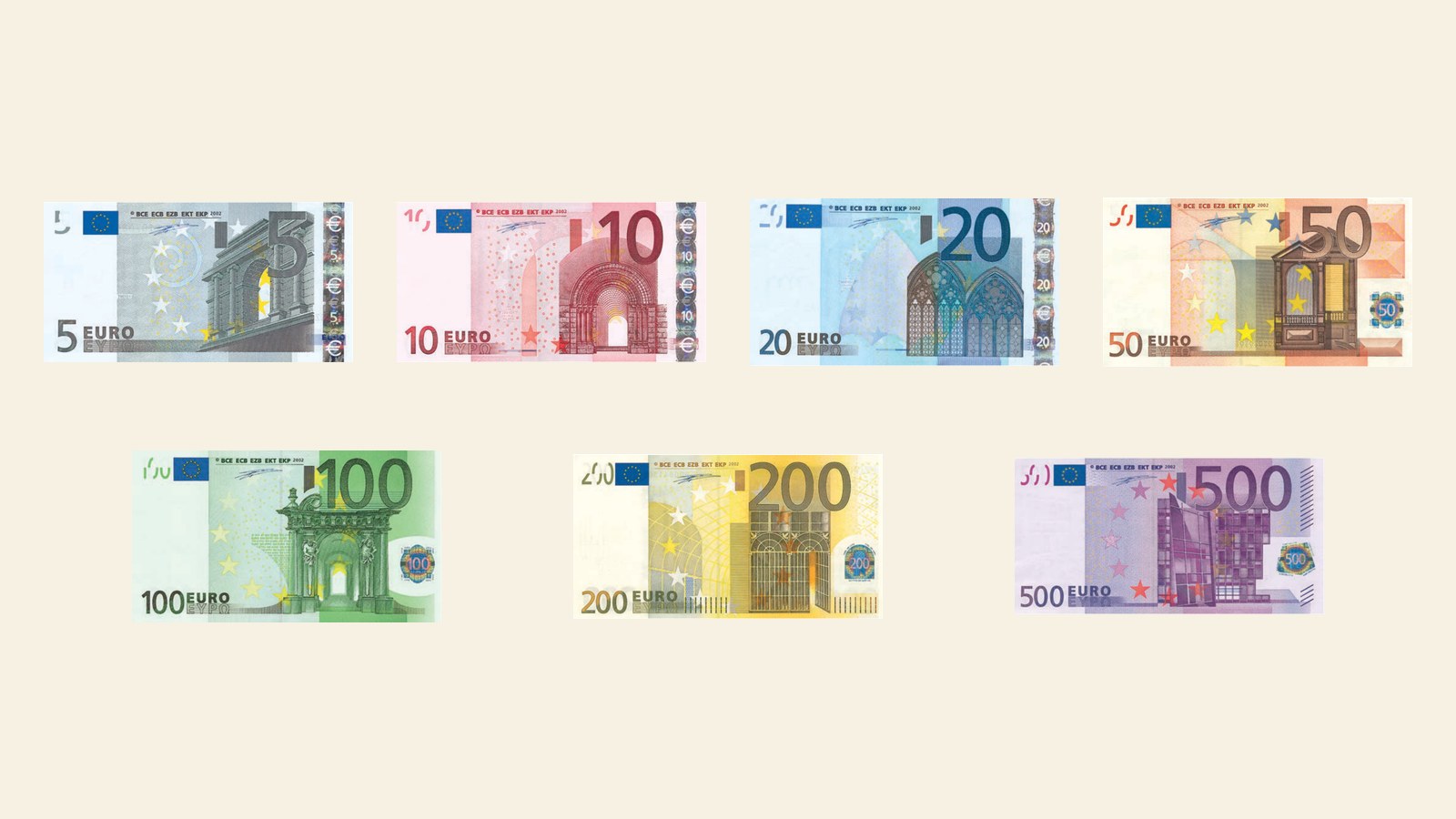
Euro banknotes do not have a national side. Their design language is shared: windows and gateways on the front, bridges on the back, denominations with common colours and sizes, and security features organised at euro-area level. This is one reason why the first series avoided real monuments and national portraits. The design had to be recognisable without belonging visually to one country.
Coins, by contrast, were designed from the beginning with a common side and a national side. The common side keeps the coin recognisable as euro cash; the national side allows each participating country to express its own motifs within agreed rules.
The result is a useful visual compromise. Banknotes emphasise a single shared design system. Coins allow national variety while remaining part of one currency.
The Italian route from mint to circulation
The Italian case shows how the general rules become a practical national process.
Banca d’Italia explains that, in Italy, euro coins are minted in Rome by the Istituto Poligrafico e Zecca dello Stato on behalf of the Ministry of Economy and Finance. The Ministry acts as the issuing body and distributes coins across the national territory using Banca d’Italia branches.
This is different from banknotes. For euro banknotes, Banca d’Italia operates within the Eurosystem framework: it contributes to production, circulation, withdrawal and replacement according to common Eurosystem rules.
For a reader, the distinction can be simplified like this:
| In Italy | Banknotes | Coins |
|---|---|---|
| Institutional framework | Eurosystem banknote framework. | National coin issue under euro-area rules. |
| Physical production | Assigned production within the Eurosystem. | Istituto Poligrafico e Zecca dello Stato. |
| National issuing body | Banca d’Italia acts as national central bank within the Eurosystem. | Ministry of Economy and Finance. |
| Distribution and public services | Banca d’Italia handles banknote circulation and replacement services. | Banca d’Italia branches support distribution and exchange procedures. |
The same pattern will not look identical in every country, because each national mint and national administrative structure is different. The principle, however, is stable: banknotes belong to the Eurosystem banknote framework; coins remain a national competence inside common euro rules.
Commemorative and collector coins
The national side also explains why euro coins can carry commemorative designs.
The ECB and the European Commission both describe 2 euro commemorative coins as legal tender throughout the euro area. They have the same common side and technical properties as normal 2 euro coins, but a special commemorative design on the national side.
Collector coins are a separate category. The European Commission notes that collector coins are not intended for general circulation and their designs must not be too similar to normal euro coins in order to avoid confusion. Banca d’Italia makes a similar distinction for Italy: ordinary collector sets can belong to the normal circulating denomination range, while precious-metal collector coins with non-standard denominations circulate only in the issuing country.
Not every euro-denominated object should be treated in the same way. A normal circulating coin, a 2 euro commemorative coin, a collector coin and a souvenir object may all use euro-related imagery or denominations, but their legal and practical status can differ.
When coins are worn or damaged
Worn or damaged cash also follows different routes depending on whether it is paper money or metal money.
For banknotes, replacement is normally handled through national central banks under ECB and Eurosystem rules. For coins, the path can involve the national mint. In Italy, worn or damaged euro coins may be presented at Banca d’Italia branches or to professional operators and, when assessment is needed, forwarded to the Istituto Poligrafico e Zecca dello Stato. The State Printing Works and Mint is responsible for assessing whether worn or damaged coins are eligible for reimbursement.
The practical lesson is simple: the coin system is not just the banknote system in metal form. Different institutions and procedures can become relevant depending on whether the cash object is a banknote or a coin.
The distinction you see in a wallet
The simplest way to read euro cash is to separate appearance, issuing authority and circulation.
A euro banknote has a common design because banknotes are organised through the Eurosystem. Its production may involve a national central bank and a security printing works, but the public design is not national.
A euro coin has a national side because coins are issued by euro-area countries. That national side identifies the issuing country, but it does not make the coin local-only cash. Normal euro coins and 2 euro commemorative coins circulate throughout the euro area.
The distinction is useful beyond administration. It explains why the euro has one banknote family but many coin faces, why coin designs change through national and Commission procedures, and why damaged coins may follow a different exchange path from damaged banknotes.
One currency, then, does not mean one identical institutional route for every object. Euro banknotes and euro coins meet in the wallet, but they arrive there through different parts of the European cash system.

_(5133941308).jpg)