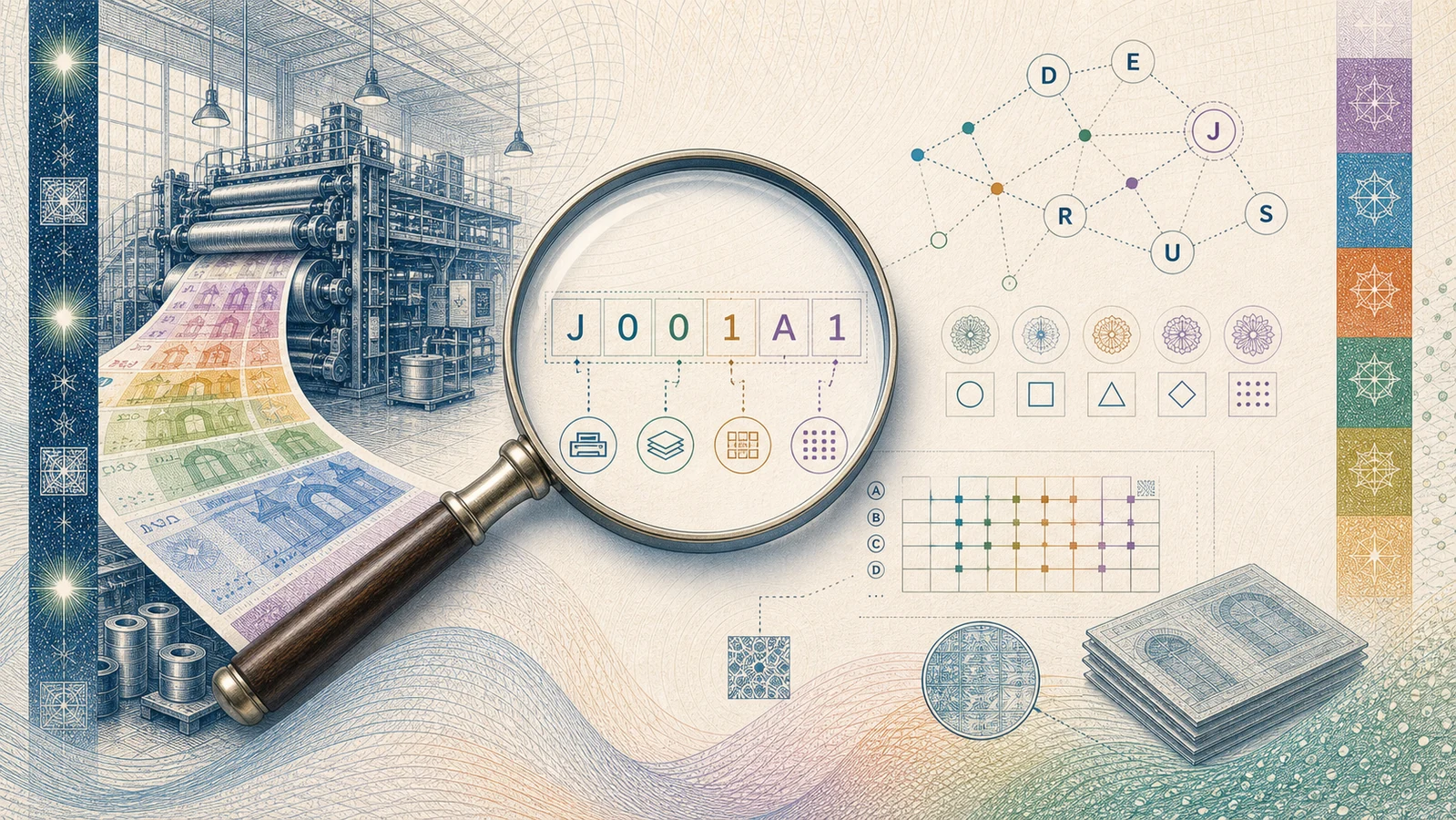
The serial number is the code most people notice first on a euro banknote. The printer code is different. It is shorter, less obvious and more technical: a production clue rather than a public-facing identifier.
For collectors, this small code is important because it connects a note to the way it was physically made. It can point to the printing works, the printing plate and the position of the note within the printed sheet. Read carefully, it helps separate production history from assumptions about nationality, rarity or value.
The first rule is simple: a printer code is useful only when the series is identified correctly. The first euro banknotes and the Europa series use related ideas, but not the same letter logic.
Start with the short code
A standard first-series example is:
J001A1
This is not the serial number. It is a short production code. The form can be read in three parts:
| Part | Meaning | Example |
|---|---|---|
J | The printing works. | In the first series, |
001 | The printing plate, often called the cliché in collector literature. | The first numbered plate used for that production context. |
A1 | The position of the banknote within the printed sheet. | A row-and-column coordinate, like a sheet-position reference. |
The short code therefore belongs beside the serial number, not inside it. The serial number identifies a note within the numbering system; the short code points back to production.
The code is printed within the offset-printed elements. On the first series its position changes with the denomination — above the hologram patch on the 50 euro, on a star on the 10, 20, 200 and 500, near the O of EURO on the 5 — and the first-series catalogue lists all seven. The Europa series settled it: the code sits top right on every denomination, set vertically beside the holographic stripe.
Production is a Eurosystem task
Euro banknote production is not organised as one country printing only “its own” notes. The ECB describes banknote production as a joint process involving the national central banks and the ECB. Annual production volumes are based on forecasts, replacement needs and logistical stocks, and production is assigned across high-security printing works in Europe.
Banca d’Italia describes the same logic from the Italian side: within the Eurosystem, it produces the quantity of banknotes assigned to it, puts notes into circulation and helps maintain the quality and integrity of circulating cash.
That matters because printer codes are often misread as national labels. A printing works can produce notes for a central bank other than the one in its own country. The code should therefore be treated as a production reference, not as a simple statement of where a banknote was issued or where it circulated.
A printing works often specialises in a few denominations — in most cases two — and only a few countries have printed at least one of every denomination, so the central banks exchange the denominations they produce before issue. For the Europa series, only Austria, France and Italy have printed at least one of every denomination of both the first and the second series at their own works.
First series: national letter and printer letter
The first series has two different letter systems that are easy to confuse.
The long serial number begins with a national letter. In the first series, Italy is associated with S. That letter points to the national central bank associated with the issue, not automatically to the physical place of printing.
The short production code begins with a printer letter. In the first-series printer-code table, Banca d’Italia is identified by J. That is why an Italian first-series example can involve both letters: S in the serial-number logic and J in the production-code logic.
The first-series printer-code table lists fourteen active printer letters, plus reserved or unused entries. Letters such as B, I, O and Q are avoided because they can be confused with numbers or other characters.
The full first-series printer-code table, reconstructed from the source spreadsheet, is:
| Letter | Printing works | Country | City |
|---|---|---|---|
A | Reserved — Bank of England, Loughton, United Kingdom. Never used for euro banknote production. | ||
C | Reserved — AB Tumba Bruk, Tumba, Sweden. Never used for euro banknote production. | ||
D | Setec Oy | Finland | Vantaa |
E | F.C. Oberthur | France | Chantepie |
F | Österreichische Banknoten | Austria | Vienna |
G | Johan Enschedé & Zn. | Netherlands | Haarlem |
H | De La Rue | United Kingdom | Gateshead |
J | Banca d’Italia | Italy | Rome |
K | Central Bank of Ireland | Ireland | Dublin |
L | Banque de France | France | Chamalières |
M | Fábrica Nacional de Moneda y Timbre | Spain | Madrid |
N | Bank of Greece | Greece | Athens |
P | Giesecke & Devrient | Germany | Munich and Leipzig |
R | Bundesdruckerei | Germany | Berlin |
S | Reserved — Danmarks Nationalbank, Copenhagen, Denmark. Never used for euro banknote production. | ||
T | National Bank of Belgium | Belgium | Brussels |
U | Valora | Portugal | Carregado |
Letters B, I, O and Q are not assigned because they are easy to confuse with digits or with other letters. Letters A, C and S were reserved for printing works of central banks that never adopted the euro and therefore never produced euro banknotes.
Europa series: the logic becomes tighter
The Europa series keeps the short production code, but the letter logic changes.
In the Italian example, the sequence becomes:
S001A1
The form is familiar: printer letter, plate number and sheet position. But the first letter is no longer J. In the Europa-series system, the Banca d’Italia printing works is associated with S. The same letter can also appear as the first letter of the serial number.
This is one of the cleanest differences between the two series:
| Question | First series | Europa series |
|---|---|---|
| What does the first serial letter mainly indicate? | The national central bank associated with the issue. | The printing works associated with the note. |
| Italian production-code example | J001A1 | S001A1 |
| Main reading risk | Confusing national letter with physical printing location. | Forgetting that the code is still not proof of authenticity or rarity. |
The Europa-series printer table is also broader in letter range than the active first-series list. Some letters are assigned to printing works, some remain unassigned or unused, and some offices have changed letter between the first and second series. The Italian shift from J to S is the easiest example to remember.
The full Europa-series printer-code table, reconstructed from the source spreadsheet, is:
| Letter | Printing works | Country | Control number | First-series letter |
|---|---|---|---|---|
D | Polska Wytwórnia Papierów Wartościowych | Poland | — | — |
E | Oberthur Fiduciaire SAS (Chantepie) | France | 3 | E |
F | Oberthur Fiduciaire AD (Sofia) | Bulgaria | — | — |
H | De La Rue Currency (Loughton) | United Kingdom | — | A |
J | De La Rue Currency (Gateshead) | United Kingdom | — | H |
M | Valora | Portugal | 4 | U |
N | Oesterreichische Banknoten und Sicherheitsdruck | Austria | 3 | F |
P | Joh. Enschede Security Printing | Netherlands | 1 | G |
R | Bundesdruckerei | Germany | 8 | R |
S | Banca d’Italia | Italy | 7 | J |
T | Central Bank of Ireland | Ireland | 6 | K |
U | Banque de France | France | 5 | L |
V | IMBISA (Banco de España) | Spain | 4 | M |
W | Giesecke & Devrient (Leipzig) | Germany | 3 | P |
X | Giesecke & Devrient (Munich) | Germany | 2 | P |
Y | Bank of Greece | Greece | 1 | N |
Z | National Bank of Belgium | Belgium | 9 | T |
The control-number column records the small single digit that each assigned Europa-series printer letter carries in the source spreadsheet, used for production-code checksum operations. A few letters do not show a control number because the corresponding printer letter has not yet been wired into the published checksum table. The Europa-series letters A, B, C, G, K and L are also part of the system but currently sit as “not assigned” — they remain available for printing works that may join Europa-series production later. The letters I, O and Q stay out of the scheme entirely, for the same reason as in the first series: they look too much like digits.
Two patterns are visible at once. Many Europa-series letters reuse the first-series national letter of the country the printing works is based in: Italy’s printing works moves from J to S, France’s central printing works moves from L to U, and so on. A few offices remain on the same letter, like Bundesdruckerei on R. New entries appear for printing works that joined Europa-series production (Poland on D, Sofia on F), and a single first-series entry can split into two letters when production is separated into different cities, as with Giesecke & Devrient on W for Leipzig and X for Munich.
Plate numbers and sheet positions
The middle part of the short production code is the plate number. In the source documents this is described as the cliché number. Each printing works numbers the offset plates it uses, starting from 001.
A missing number is not automatically mysterious. A plate number may be skipped if a plate is defective or unsuitable. For that reason, gaps in the sequence should be treated cautiously. They may be technical production traces, not rarity signals by themselves.
The final part, such as A1, is the position of the note within the sheet. The system works like coordinates: the letter identifies the row and the number identifies the column. It is a way to locate where that note sat before the sheet was cut.
This sheet-position logic is one reason printer codes are attractive to collectors. They make an ordinary banknote feel less anonymous. But the interpretation still depends on series, denomination, printer and documented data.
First-series sheet layouts by denomination
The number of notes printed on one sheet, and therefore the set of valid position codes, depends on the denomination. The four grids below give every valid first-series sheet-position code for the Banca d’Italia sheets, as catalogued by Gerardo Vendemia.
| Row \ Col | 1 | 2 | 3 | 4 | 5 | 6 |
|---|---|---|---|---|---|---|
| A | A1 | A2 | A3 | A4 | A5 | A6 |
| B | B1 | B2 | B3 | B4 | B5 | B6 |
| C | C1 | C2 | C3 | C4 | C5 | C6 |
| D | D1 | D2 | D3 | D4 | D5 | D6 |
| E | E1 | E2 | E3 | E4 | E5 | E6 |
| F | F1 | F2 | F3 | F4 | F5 | F6 |
| G | G1 | G2 | G3 | G4 | G5 | G6 |
| H | H1 | H2 | H3 | H4 | H5 | H6 |
| I | I1 | I2 | I3 | I4 | I5 | I6 |
| J | J1 | J2 | J3 | J4 | J5 | J6 |
| Row \ Col | 1 | 2 | 3 | 4 | 5 | 6 |
|---|---|---|---|---|---|---|
| A | A1 | A2 | A3 | A4 | A5 | A6 |
| B | B1 | B2 | B3 | B4 | B5 | B6 |
| C | C1 | C2 | C3 | C4 | C5 | C6 |
| D | D1 | D2 | D3 | D4 | D5 | D6 |
| E | E1 | E2 | E3 | E4 | E5 | E6 |
| F | F1 | F2 | F3 | F4 | F5 | F6 |
| G | G1 | G2 | G3 | G4 | G5 | G6 |
| H | H1 | H2 | H3 | H4 | H5 | H6 |
| I | I1 | I2 | I3 | I4 | I5 | I6 |
| Row \ Col | 1 | 2 | 3 | 4 | 5 |
|---|---|---|---|---|---|
| A | A1 | A2 | A3 | A4 | A5 |
| B | B1 | B2 | B3 | B4 | B5 |
| C | C1 | C2 | C3 | C4 | C5 |
| D | D1 | D2 | D3 | D4 | D5 |
| E | E1 | E2 | E3 | E4 | E5 |
| F | F1 | F2 | F3 | F4 | F5 |
| G | G1 | G2 | G3 | G4 | G5 |
| H | H1 | H2 | H3 | H4 | H5 |
| Row \ Col | 1 | 2 | 3 | 4 |
|---|---|---|---|---|
| A | A1 | A2 | A3 | A4 |
| B | B1 | B2 | B3 | B4 |
| C | C1 | C2 | C3 | C4 |
| D | D1 | D2 | D3 | D4 |
| E | E1 | E2 | E3 | E4 |
| F | F1 | F2 | F3 | F4 |
| G | G1 | G2 | G3 | G4 |
A position code only makes sense when it falls inside the relevant grid. For example, I6 is a valid 10 € or 20 € position but not a valid 50 €, 100 € or 200 € position, where the sheet stops at row H and column 5. Treating the four grids as a quick validity check is one of the simplest uses of the production code.
The same four grids also describe the Europa-series sheets produced at Banca d’Italia, because the physical sheet sizes for each denomination did not change. The only difference is the printer letter: an Europa-series production code printed at Banca d’Italia starts with S instead of J, so a Banca d’Italia 50 € Europa-series example reads as S001A1 with the same A-to-H rows and 1-to-5 columns. The 500 € denomination is not issued in the Europa series, so the 7 × 4 grid effectively applies only to the first-series 500 €.
First-series catalogue variants
The same printer-letter, plate and signature data also feed the variant catalogue used by Italian collectors. In the XIII edition of La Cartamoneta Italiana, every first-series denomination has its own BCE catalogue number: BCE 1 for the 5 €, BCE 3 for the 10 €, BCE 5 for the 20 €, BCE 7 for the 50 €, BCE 9 for the 100 €, BCE 11 for the 200 € and BCE 13 for the 500 €. Letters a, b, c, d, e added to the number distinguish sub-variants that differ by signature, by printer letter or by plate range. The “rarity” column uses the catalogue’s standard scale: C for common, C2 for very common, NC for not common.
The four tables below give the variant structure of the first-series banknotes printed at Banca d’Italia (with the few rows that fall on a different printer marked explicitly). They are grouped the same way as the sheet-layout grids above. Collector quotations are deliberately omitted: for current market values, refer to the catalogue itself.
| BCE | Year | Signature | National letter | Printer letter | Plate number | Rarity |
|---|---|---|---|---|---|---|
| BCE 1 | 2002 | Duisenberg | S | J | 001 | C |
| BCE 1 | 2002 | Duisenberg | S | J | 002 | C2 |
| BCE 1 | 2002 | Duisenberg | S | J | 003 | C2 |
| BCE 1 | 2002 | Duisenberg | S | J | 004 | C2 |
| BCE 1 | 2002 | Duisenberg | S | J | 005 | C2 |
| BCE | Year | Signature | National letter | Printer letter | Plate number | Rarity |
|---|---|---|---|---|---|---|
| BCE 3 | 2002 | Duisenberg | S | J | 001 | C |
| BCE 3 | 2002 | Duisenberg | S | J | 002–005 | C2 |
| BCE 3a | 2002 | Trichet | S | J | 006–009 | C2 |
| BCE 5 | 2002 | Duisenberg | S | J | 001 | C |
| BCE 5 | 2002 | Duisenberg | S | J | 002–010 | C2 |
| BCE 5a | 2002 | Trichet | S | J | 011–028 | C2 |
| BCE 5b | 2002 | Draghi | S | J | 029–036 | C2 |
| BCE | Year | Signature | National letter | Printer letter | Plate number | Rarity |
|---|---|---|---|---|---|---|
| BCE 7 | 2002 | Duisenberg | S | J | 001 | NC |
| BCE 7 | 2002 | Duisenberg | S | J | 002–014 | C2 |
| BCE 7a | 2002 | Trichet | S | J | 015–024 | C2 |
| BCE 7b | 2002 | Trichet | S | J | 026–055 | C2 |
| BCE 7b | 2002 | Trichet | S | F | 002–008 | C2 |
| BCE 7b | 2002 | Trichet | S | J | 057–070 | C2 |
| BCE 7b | 2002 | Trichet | S | J | 072–078 | C2 |
| BCE 7c | 2002 | Draghi | S | J | 079 | C2 |
| BCE 7d | 2002 | Trichet | S | J | 080–081 | C2 |
| BCE 7e | 2002 | Draghi | S | J | 083–093 | C2 |
| BCE 7e | 2002 | Draghi | S | J | 095–098 | C2 |
| BCE 7e | 2002 | Draghi | S | J | 100 | C2 |
| BCE 7e | 2002 | Draghi | S | J | 102 | C2 |
| BCE 9 | 2002 | Duisenberg | S | J | 001 | C |
| BCE 9 | 2002 | Duisenberg | S | J | 002–010 | C2 |
| BCE 9a | 2002 | Trichet | S | J | 011–025 | C2 |
| BCE 9a | 2002 | Trichet | S | J | 028–034 | C2 |
| BCE 11 | 2002 | Duisenberg | S | J | 001 | C |
| BCE | Year | Signature | National letter | Printer letter | Plate number | Rarity |
|---|---|---|---|---|---|---|
| BCE 13 | 2002 | Duisenberg | S | J | 001 | C |
A few observations from the variant tables themselves. Most first-series Banca d’Italia plates were signed by Duisenberg and stayed common (C or C2): the rarity scale only lifts to NC on the first 50 € plate. The Trichet signature appears on later plate ranges of the 10 €, 20 €, 50 € and 100 €. The Draghi signature shows up only sparingly on the 20 € and on a handful of late 50 € plates (BCE 7c, BCE 7e) — because by the time he signed, the Europa series was taking over. One row in the 50 € table also shows an alternate printer letter F, the Oberthur works in France, on the BCE 7b run — a reminder that production was redistributed across the Eurosystem rather than confined to Banca d’Italia.
Europa-series catalogue variants
The Europa series uses the same catalogue logic, with even catalogue numbers: BCE 2 for the 5 €, BCE 4 for the 10 €, BCE 6 for the 20 €, BCE 8 for the 50 €, BCE 10 for the 100 € and BCE 12 for the 200 €. There is no BCE 14 because no 500 € note exists in the Europa series. Sub-variants a mark a change of signature on later plates, the way 6a and 8a record the Lagarde production runs on the 20 € and the 50 €. Every Europa-series row catalogued at Banca d’Italia carries the rarity code C3, which the catalogue uses for assets that are abundant in current circulation rather than scarce by virtue of being current cash.
Three tables cover the six denominations, grouped the same way as before. The 7 × 4 block from the first series is gone because the 500 € is not produced in the Europa series.
| BCE | Year | Signature | National letter | Printer letter | Plate number | Rarity |
|---|---|---|---|---|---|---|
| BCE 2 | 2013 | Draghi | S | S | 001 | C3 |
| BCE 2 | 2013 | Draghi | S | S | 002 | C3 |
| BCE 2 | 2013 | Draghi | S | S | 003 | C3 |
| BCE 2 | 2013 | Draghi | S | S | 006 | C3 |
| BCE | Year | Signature | National letter | Printer letter | Plate number | Rarity |
|---|---|---|---|---|---|---|
| BCE 4 | 2014 | Draghi | S | S | 002 | C3 |
| BCE 4 | 2014 | Draghi | S | S | 003 | C3 |
| BCE 4 | 2014 | Draghi | S | S | 004 | C3 |
| BCE 6 | 2015 | Draghi | S | S | 001 | C3 |
| BCE 6 | 2015 | Draghi | S | S | 003–021 | C3 |
| BCE 6a | 2015 | Lagarde | S | S | 022–029 | C3 |
| BCE | Year | Signature | National letter | Printer letter | Plate number | Rarity |
|---|---|---|---|---|---|---|
| BCE 8 | 2017 | Draghi | S | S | 002–012 | C3 |
| BCE 8 | 2017 | Draghi | S | S | 014–019 | C3 |
| BCE 8 | 2017 | Draghi | S | S | 021–022 | C3 |
| BCE 8 | 2017 | Draghi | S | S | 024–037 | C3 |
| BCE 8 | 2017 | Draghi | S | S | 041 | C3 |
| BCE 8a | 2017 | Lagarde | S | S | 036–042 | C3 |
| BCE 8a | 2017 | Lagarde | S | S | 046 | C3 |
| BCE 8a | 2017 | Lagarde | S | S | 048–058 | C3 |
| BCE 8a | 2017 | Lagarde | S | S | 061–064 | C3 |
| BCE 10 | 2019 | Draghi | S | S | 002–009 | C3 |
| BCE 12 | 2019 | Draghi | S | S | 002 | C3 |
| BCE 12 | 2019 | Draghi | S | S | 004–006 | C3 |
| BCE 12 | 2019 | Draghi | S | S | 008 | C3 |
Two contrasts with the first-series tables stand out. The Europa-series Banca d’Italia rows do not split across alternative printer letters: the printer column is uniformly S, because the Europa series at Banca d’Italia was not redistributed to Oberthur or anyone else for these denominations. And the rarity scale collapses to a single value: every Europa row is C3, the catalogue’s marker for assets that are still in normal circulation. The Lagarde signature appears as the natural successor to Draghi on the 20 € and 50 € plates that came after her appointment, while the 100 € and 200 € — printed only in 2019, before she took office in November 2019 — show only the Draghi signature in this Banca d’Italia run.
The limits of the production code
A printer code should not be asked to do more than it can do.
It does not authenticate a banknote by itself. A genuine-looking code can be copied, and a code that fits the expected pattern does not replace the normal security check.
It does not automatically make a banknote rare or valuable. Rarity depends on evidence: known production, surviving examples, condition, demand, signature, denomination, series and other verified details.
It also does not prove where the note was first spent, where it circulated, or where a collector found it. Euro cash moves across borders constantly. A production clue is not a travel history.
A lookup tool for the printer codes
The article does two jobs. The text explains how to read the code without confusing it with the serial number: printer, plate, sheet position; first series versus Europa series; production clue, not authentication certificate. The tables list every assigned letter and the first-series predecessor where one exists.
The same data now also drives an interactive serial number and printer code checker: enter a printer letter or a full production code such as J001A1 to identify the printing works in either series, and choose a denomination to check whether the sheet position fits the grid — without scanning the tables by hand.

