From today, seventeen of the nineteen national central banks of the Eurosystem stop issuing the 500 euro note. It puts into effect a decision taken in 2016: the Europa series will not include the highest denomination. Germany and Austria, for organisational reasons, will continue for a few more months, until the end of April.
The staggered ending shows how coordinated euro-area decisions still have to pass through national logistics. The result is a common policy with a short practical exception, not a different legal status for the note in those two countries.
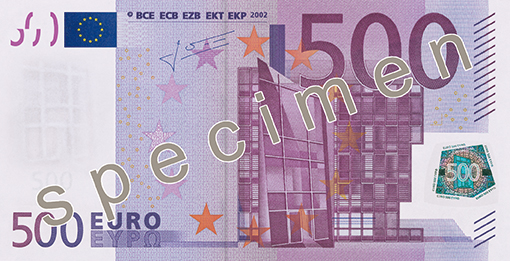
The first-series 500 euro: the only denomination without a Europa-series version.
Production had already been stopped in the preceding months; today issuance ends too, meaning the release of new notes through the central banks. From this point the 500 euro is no longer replaced: worn notes that come back in are not swapped for others of the same denomination.
That distinction is important. Ending issuance is not the same as cancelling a banknote. The decision changes what central banks put back into circulation, but it does not turn existing 500 euro notes into obsolete paper or create a deadline for holders.
The change does not affect the value held by anyone who owns a 500 euro note. The note remains legal tender, can still be used to pay, and can always be exchanged at the national central banks with no time limit. It is a point the ECB is keen to repeat, to avoid alarm among those who hold the denomination.
In ordinary use, however, the end of issuance changes expectations. A 500 euro note may still be valid, but it becomes less familiar at counters and more likely to be checked carefully because of its high face value and its shrinking role in day-to-day payments.
Behind the decision is the concern that the high value could facilitate illicit activity, making it convenient to move large sums in little space. The 500 euro was in any case not among the denominations most used in everyday payments: its role was mainly as a store of value.
For collectors, the 500 euro becomes a boundary object. It belongs to the original euro set and remains valid, but it is excluded from the current production family. Condition, signature, printer code and national-letter details therefore become more visible parts of its story as the note becomes less common in ordinary circulation.
The 500 euro is therefore not replaced by a Europa version: the new series stops at the 200 euro, while the 500 notes already in circulation will continue their life until they return on their own to the central banks.

