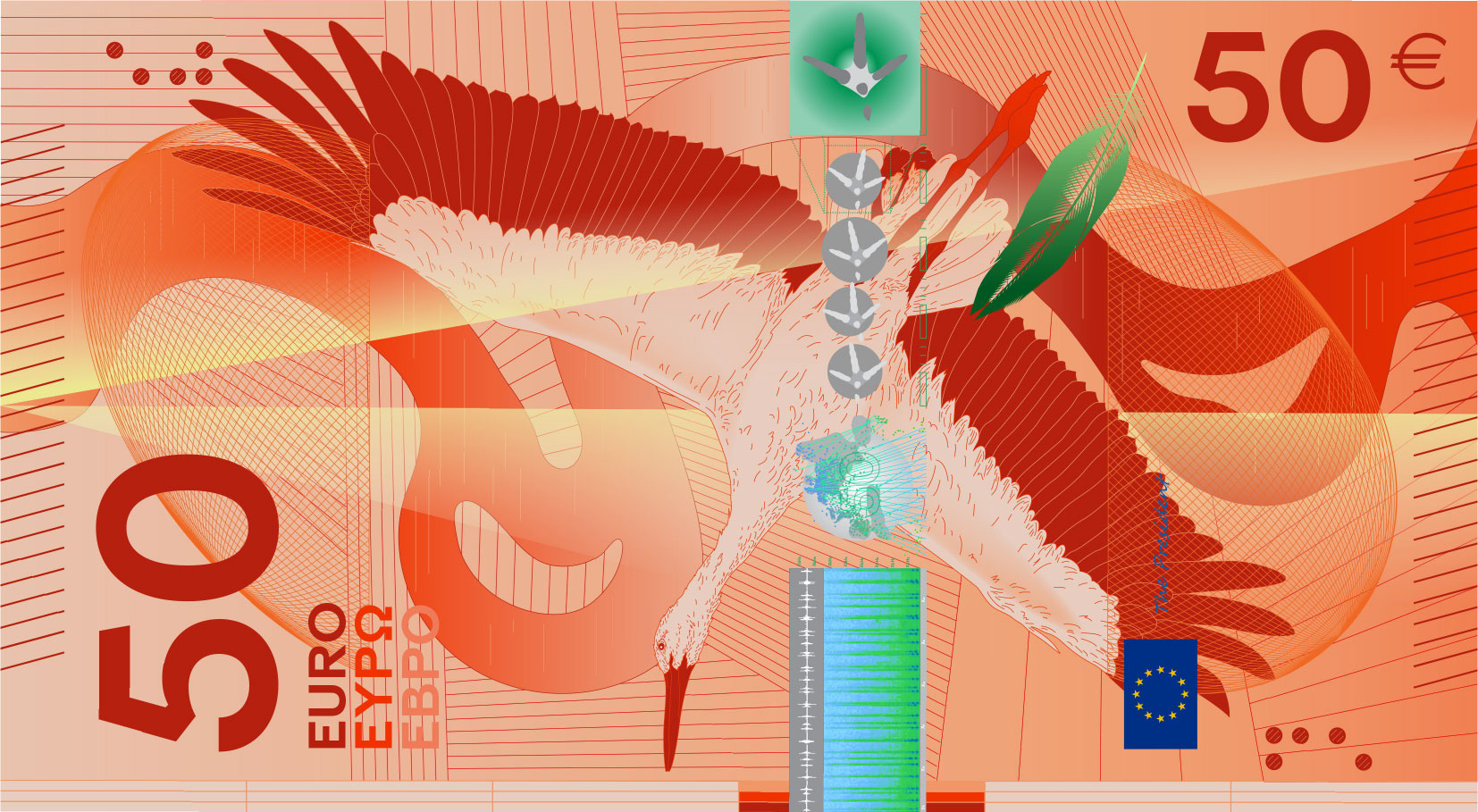
Twenty years after the first euro banknotes entered circulation, the European Central Bank announces today that it intends to redesign them. There is no new note to look at and no security feature to learn: what is launched is a process, built around the opinions of European citizens, that is expected to lead to a final decision in 2024.

The Europa-series 50 euro, the most used denomination: the current face of the euro that the process announced today puts under review.
The reasoning is openly generational. The “ages and styles” theme, with its windows, doorways and bridges, was chosen in the 1990s precisely because it favoured no country and no person. After two decades, the ECB wants to ask a different question: which images do Europeans actually recognise themselves in? President Christine Lagarde frames it plainly — banknotes are here to stay, and “it’s time to review the look of our banknotes” so that Europeans of all ages and backgrounds can relate to them.
The announcement is also a statement about cash itself. The ECB recalls that banknotes remain the most used means of payment in face-to-face retail transactions, and that demand for cash actually grew during the pandemic, driven by its role as a store of value. An institution that expected banknotes to fade away would not invest years of work in redrawing them.
The process is laid out step by step. Focus groups will first gather opinions across the euro area on possible themes. A theme advisory group, with one expert from each euro-area country, will distil them into a shortlist for the Governing Council. The public will then be consulted on the shortlisted themes, a design competition will follow, and the public will be heard again on its results before the Governing Council takes the final decision, expected in 2024. Only afterwards will the ECB decide when the new notes are produced and issued. Board member Fabio Panetta sums up the intent: notes that citizens can identify with and be proud to use.
Just as clearly, the announcement says what does not change. The Europa series remains the money in people’s wallets, no withdrawal is planned, and nothing announced today alters how a note is used or checked at the till. The redesign concerns the euro’s future look, not the validity of its present one.
The 2024 target, seen from later years, proves optimistic. The themes — “European culture” and “Rivers and birds” — arrive in November 2023, the motifs in January 2025 and the design contest in July 2025, with the final choice still ahead. The dates slip, but the path followed is exactly the one announced today.
For collectors, the interest of this date is its position in the sequence. The first series was announced in the 1990s, the Europa series in 2012; today’s decision means that a third generation of euro banknotes is now on its way, and that the Europa series — completed only in 2019 — will not be the last word on how the euro looks.