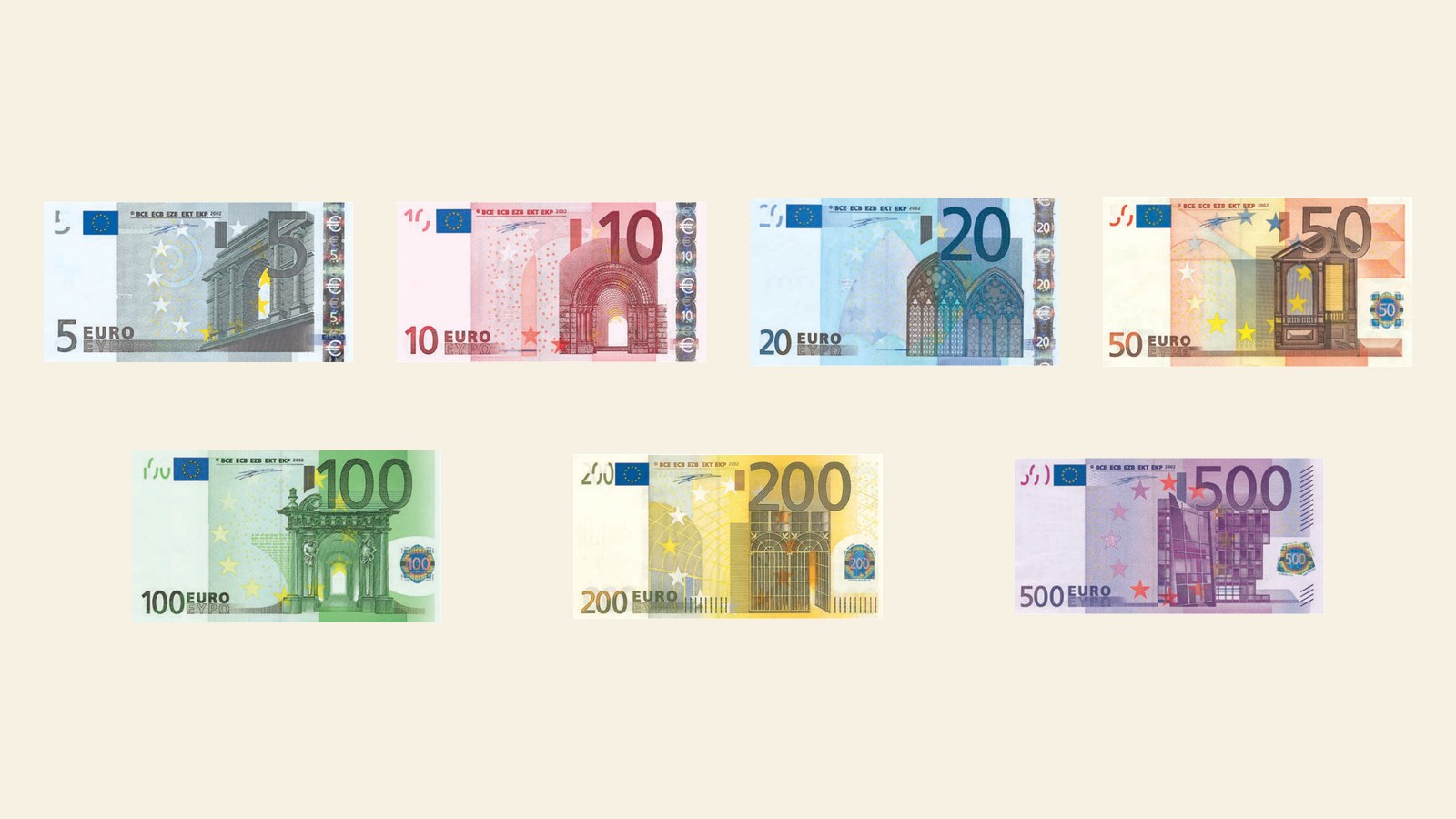
The euro does not yet exist as cash, and will not for another five years, but today its face is decided. Meeting in Frankfurt, the Council of the European Monetary Institute — the body that prepared the ground for the European Central Bank — chooses the design that will appear on the first euro banknotes.

The chosen design: a window on the front and, on the back, a bridge. Here the first-series 20 euro.
The winning series is the work of Robert Kalina, a designer at the Oesterreichische Nationalbank, the Austrian central bank. It was selected through a competition in which designers from across the European Union submitted proposals along two possible lines: a theme called “Ages and styles of Europe” and a more abstract, modern one. The jury and then the EMI Council preferred the first.
Kalina’s idea solves a delicate problem. Banknotes shared by many countries cannot show national monuments or famous people without appearing to favour one nation over another. His answer is to depict architectural styles rather than real buildings: seven periods of European architecture, one for each denomination, from Classical antiquity to twentieth-century modernism.
The front of each note carries windows and doorways, chosen to suggest openness and the spirit of a new Europe; the back carries a bridge, a symbol of connection between the peoples of the continent and with the wider world. None of the structures exists in reality, precisely so that no country can claim the image as its own.
A few days later the designs are presented publicly at the European Council in Dublin, to the heads of state and government of the member states. From that point they stop being a competition entry and become the visual identity of the future single currency.
The years that follow are spent turning the drawings into a printable, secure banknote: refining the artwork, adding watermark, security thread, hologram and the other defences, and preparing production across the printing works of the participating countries. The notes themselves enter circulation only on 1 January 2002.
The decision taken today proves remarkably durable. The design language set in 1996 — windows, bridges, the seven ages of European architecture — carries through the whole first series and is then kept, with a lighter touch, in the Europa series that begins in 2013. It is still the frame through which euro banknotes are read.