The European Central Bank announces today that the 500 euro note, the highest denomination in the euro family, will not be part of the Europa series and that its production and issuance will come to an end. The Governing Council frames the decision carefully, because a note of that value is as much a store of wealth as a means of payment.
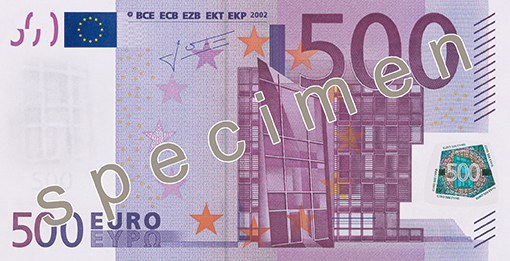
The 500 euro: from today it has no future in the Europa series, and remains a first-series note only.
Behind the choice is a concern the ECB states plainly: the high value of the note could make it easier to move large sums of money in little space, and so to facilitate illicit activity. The 500 euro was in any case never among the denominations most used in everyday payments; its role was mainly to hold value rather than to change hands at the till.
The Bank is equally careful about what the decision does not mean. Ending production and issuance is not the same as cancelling the note. The 500 euro remains legal tender, can still be used to pay, and can always be exchanged at the national central banks with no time limit. Existing notes keep their value and are not turned into a deadline for the people who hold them.
The announcement also sets a rough timetable: issuance is to stop around the end of 2018, in step with the arrival of the 100 and 200 euro notes that will complete the Europa series. In practice the date is later fixed at the start of 2019, with Germany and Austria continuing for a few more months for organisational reasons.
The move leaves the 500 euro as the only original denomination without a Europa-series successor. The new series, redesigned one note at a time since 2013, will stop at the 200 euro; there will be no purple note among the renewed designs.
For the public, little changes overnight: a 500 euro note received today is exactly as valid tomorrow. What changes is expectation. As the note is no longer replaced, it slowly becomes less familiar at counters and more likely to be examined closely because of its face value.
For collectors, the decision quietly turns the 500 euro into a boundary object. It belongs fully to the original euro set and stays valid, but it is shut out of the current production family, so its condition, signature, printer code and national letter become a larger part of its story. The end of issuance itself follows in 2019.
