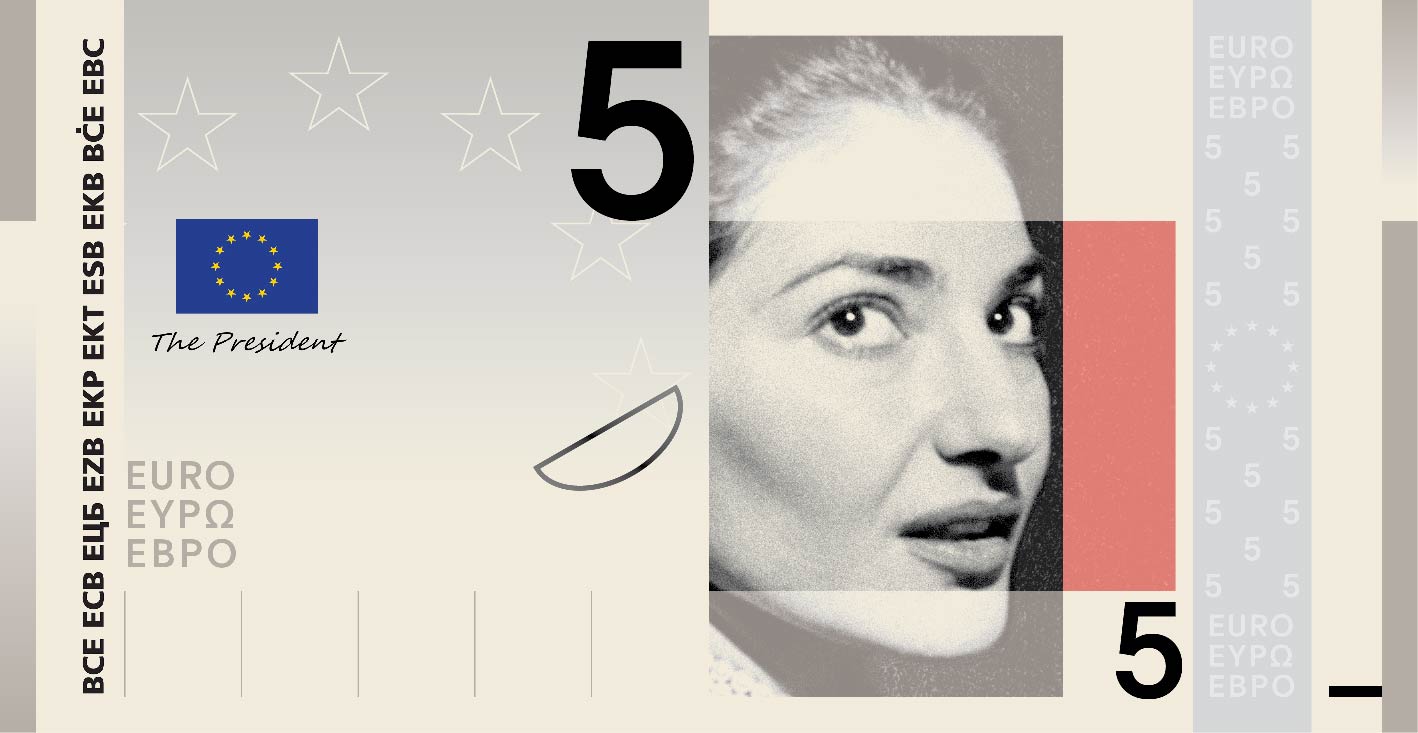
The public consultation on the next euro banknotes has closed with an exceptional turnout. Between 23 July and 21 September 2026, 9.96 million people completed the European Central Bank’s online survey on the ten shortlisted design families; the ECB published the figure on 23 September.
“This amazing number shows how much interest Europeans have in their future banknotes,” said ECB President Christine Lagarde. The count covers fully completed questionnaires only, and the respondents in the euro area alone amount to about 2.6% of its population.
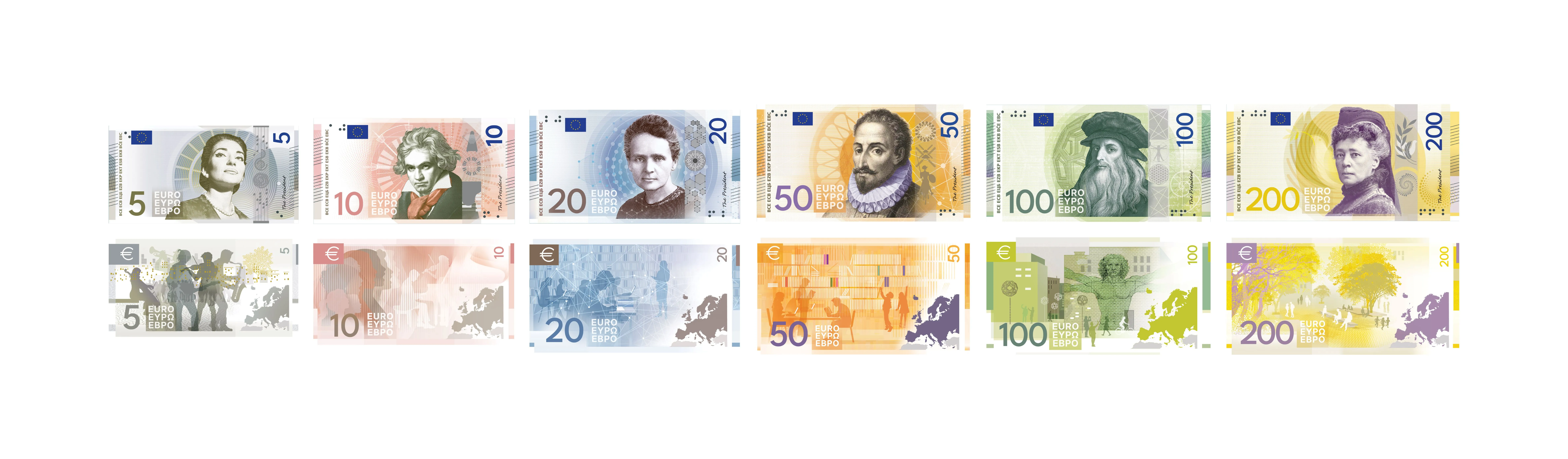
Design E by Myrsini Vardopoulou, one of the ten families submitted to the survey. The ECB has not published results for individual proposals; the image is a proposal, not an issued or approved banknote.
Where the responses came from
An annex to the ECB announcement breaks the total down by the country respondents declared. Of the 9,960,495 completed surveys, 9,387,044 came from the 21 euro-area countries and 9,778,025 from the European Union as a whole; 75,620 respondents lived outside the EU and 106,850 preferred not to say.
Germany alone contributed about 3.55 million responses, more than a third of the total. Measured against population, participation was highest in Austria (5.09%), Germany (4.25%), Luxembourg (3.68%) and the Netherlands (3.48%), and lowest in Croatia (1.36%) and Slovakia (1.42%). Italy recorded 1,103,118 responses, 1.87% of its population. Non-euro EU countries also took part, with Poland the largest at 199,176.
| Euro-area country | Completed surveys | Share of population |
|---|---|---|
| Austria | 469,166 | 5.09% |
| Belgium | 292,221 | 2.44% |
| Bulgaria | 113,867 | 1.77% |
| Croatia | 52,623 | 1.36% |
| Cyprus | 18,519 | 1.86% |
| Estonia | 31,623 | 2.32% |
| Finland | 128,978 | 2.28% |
| France | 1,293,327 | 1.87% |
| Germany | 3,549,542 | 4.25% |
| Greece | 159,457 | 1.54% |
| Ireland | 83,412 | 1.51% |
| Italy | 1,103,118 | 1.87% |
| Latvia | 37,137 | 2.01% |
| Lithuania | 55,471 | 1.92% |
| Luxembourg | 25,416 | 3.68% |
| Malta | 9,681 | 1.65% |
| Netherlands | 630,117 | 3.48% |
| Portugal | 214,491 | 1.88% |
| Slovakia | 76,894 | 1.42% |
| Slovenia | 45,436 | 2.13% |
| Spain | 996,548 | 2.01% |
| Euro area | 9,387,044 | 2.61% |
The figures are self-declared by respondents; the population shares are calculated by the ECB on 2026 Eurostat data.
A consultation driven by younger Europeans
The age profile is the most unexpected result. Almost two-thirds of the responses came from people under 35: 27.9% from the 18–24 group, 26.8% from 25–34 and 10.1% from respondents under 18. People aged 65 or older supplied only 3.8%.
| Age group | Completed surveys | Share of respondents |
|---|---|---|
| Under 18 | 1,003,282 | 10.1% |
| 18–24 | 2,780,731 | 27.9% |
| 25–34 | 2,665,854 | 26.8% |
| 35–44 | 1,362,024 | 13.7% |
| 45–54 | 897,440 | 9.0% |
| 55–64 | 701,007 | 7.0% |
| 65 or older | 378,287 | 3.8% |
| Prefer not to say | 171,834 | 1.7% |
That imbalance explains why the raw preferences cannot be read as a picture of the euro area. An open survey records those who chose to answer, so the ECB will analyse the data with standard statistical methods before drawing conclusions. It also ran a second survey, with the same questions, through an independent research company on a representative sample of euro-area residents; that survey was still being finalised when the participation figures were released.
No preferred design has been announced
The ECB is not publishing the results for individual proposals at this stage. Any claim that one design “won” the survey therefore has no official basis. The Governing Council will weigh four inputs together: the two surveys, the recommendations of the independent Design Contest Jury and a technical assessment of each family.
The decision on the final design concept is expected around the end of 2026. Only then will the ECB publish a detailed report on both surveys, including the feedback received on each proposal and the results for individual countries.
From the chosen concept to banknotes in circulation
The selected family will not be printed as it appears in the survey. It will be adapted and developed into working banknotes, with enhanced security features and improvements in accessibility and sustainability. According to the ECB, the new notes should enter circulation gradually from the early 2030s.
Euro banknotes in circulation today will remain valid and continue to circulate alongside the new series. The ten candidate families remain available for comparison in the shortlist article and on the dedicated page for each proposal.